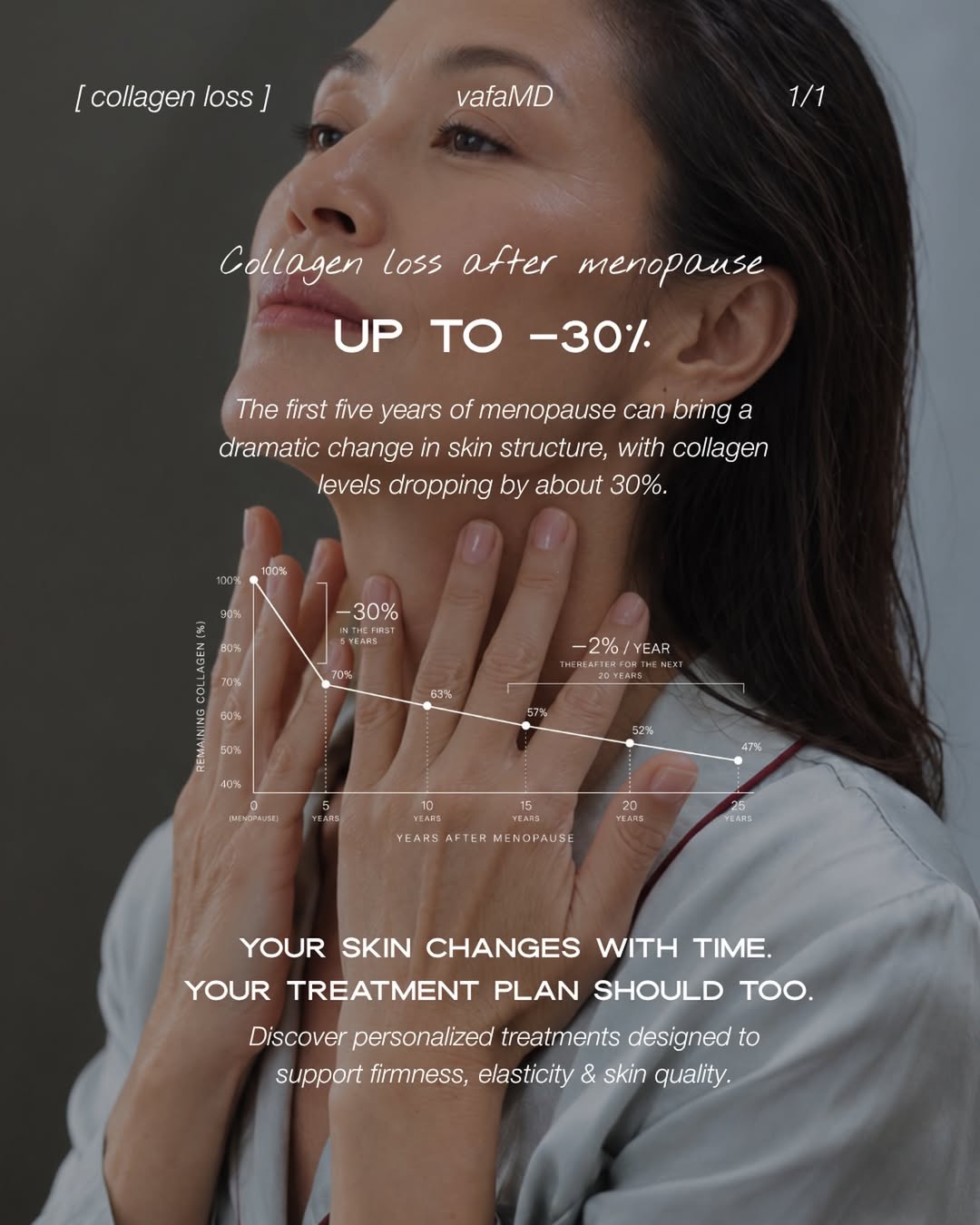
What happens to skin collagen in the first five years of menopause
Collagen can drop by about 30 percent in the first five years after menopause, which changes how we think about timing a treatment plan.
VAFAMD STAFFTurn your social into search
We turn your posts into editorial stories that bring new search traffic to vafamd.com. Three of yours will be on this page.
Book a demo
vafamd 💉Collagen stimulation has always been part of our philosophy 💉We favor treatments that work with the skin. supporting collagen, structure and skin quality over time. Because the best treatment plan isn’t about chasing every new thing. It’s about knowing what’s worth doing, and when. 💉The goal isn’t to freeze time. It’s to invest in how your skin ages. Curious where to start? Schedule a consultation with one of our providers and we’ll build a plan around you
Collagen can drop by about 30 percent in the first five years after menopause, which changes how we think about timing a treatment plan.
VAFAMD STAFFHow it works
Same as today. Nothing changes on Instagram.
We turn your post into a full story in your voice within the hour.
One click publishes it to vafamd.com. Nothing goes live without you.
Your stories
Nothing was published anywhere. You decide that. Every word will come from your own posts, your own photos and your own treatments.
collagen loss · From your post
Collagen can drop by about 30 percent in the first five years after menopause, which changes how we think about timing a treatment plan.
“💉Collagen stimulation has always been part of our philosophy 💉We favor treatments that work with the skin. supporting collagen, structure and skin quality over time. Because the best treatment plan isn’t about chasing every new thing. It’s about knowing what’s worth doing, and when. 💉The goal isn’t to freeze time. It’s to invest in how your skin ages. Curious where to start? Schedule a consultation with one of our providers and we’ll build a plan around you”
Treatment Notes · From your post
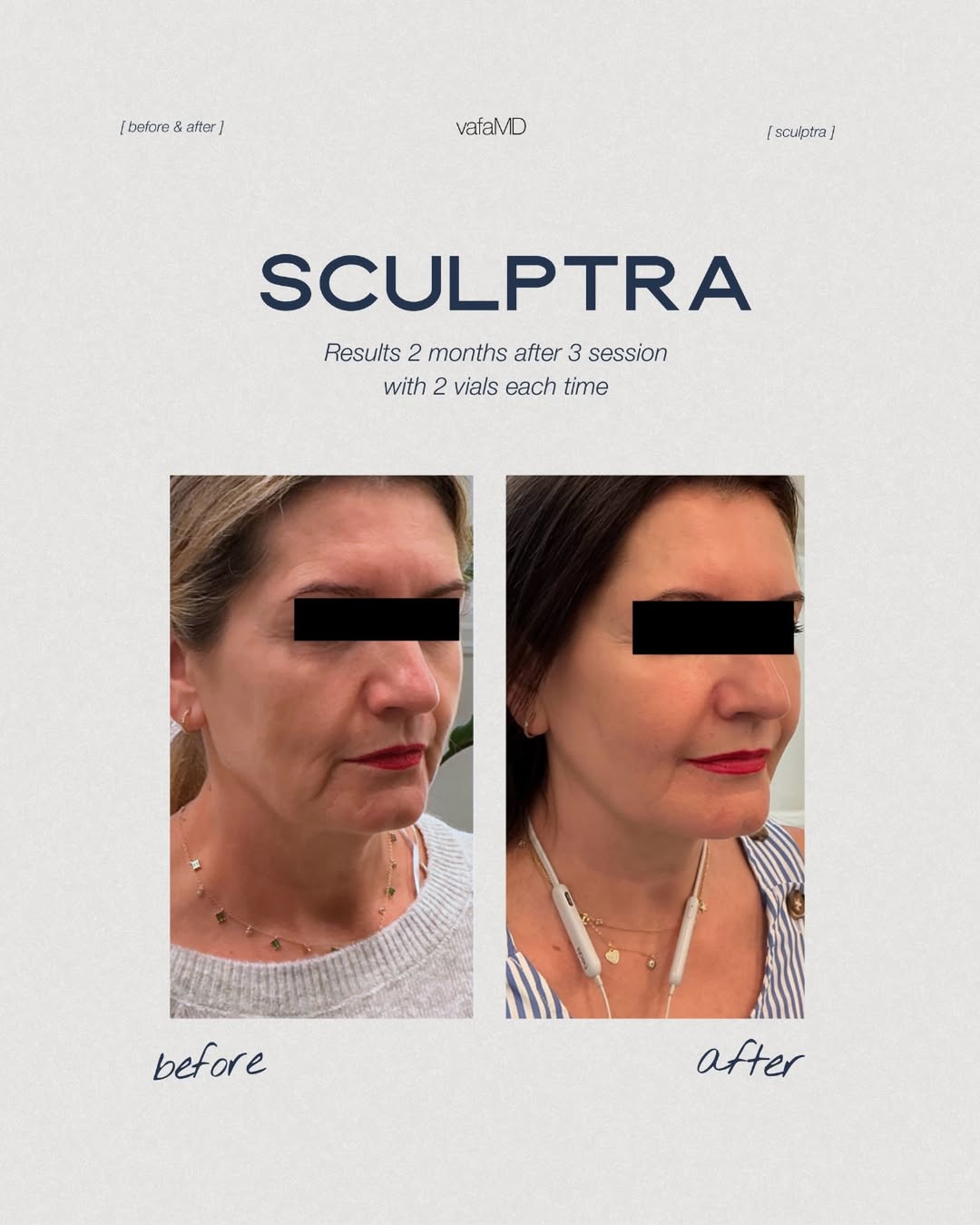
A look at the biostimulator treatment we use to rebuild volume and structure gradually, in the patient's own timeline.
“Signature Sculptra Treatment 💉💉💉 ⠀ WHAT IT DOES. This biostimulator treatment, enhances and restores facial volume, facial structure, and skin firmness. ⠀ PRODUCT. Sculptra/ Poly L Lactic Acid ⠀ TECHNIQUE. Quad vector Tri modal injection technique ⠀ ⠀ RESULTS. Results will be seen in 8 weeks ⠀ ⠀ ANESTHESIA. Local and Topical⠀ ⠀ TIME. 15 20 minutes⠀ ⠀ RECOVERY. None⠀ ⠀ LASTS. 2 3 years (may require multiple treatments)⠀ ⠀ **individual results may vary ⠀ Call, Email or DM to⠀ schedule a complimentary consultation ◾️(347) 348 4753 ◾️ info@vafamd.com ◾️ Soho. 110 Greene St. ◾️ UES. 820 Park Ave. ⠀ #sculptra #sculptranyc #sculptrafacelift #sculptrabeforeandafter plla polyllacticacid vafamd”
Patient Notes · From your post
At vafaMD, natural looking results come from collagen doing its job slowly, not from a single visit.
“The key to natural looking results? A little collagen and a little patience 💉#sculptra”
One social post becomes another searchable entry point to vafaMD.
Our own magazine. Clicks and citations from Google Search Console, as of September 15, 2026.
Draft story for vafamd.com · collagen loss
Collagen can drop by about 30 percent in the first five years after menopause, which changes how we think about timing a treatment plan.
The number worth sitting with is 30 percent. That is roughly how much collagen the skin can lose in the first five years after menopause, a decline steep enough to change the structure, firmness, and quality of skin faster than most other stretches of life. After that initial drop, the rate slows to about 2 percent a year for the next two decades, but the early years carry the biggest shift.
That timeline matters because it reframes the question patients bring us. It is rarely just what should I do. It is when should I do it. A treatment plan built around a graph like this looks different than one built around a single concern in isolation, because it accounts for a curve that is steep at first and then gradual, not a flat line.
Collagen stimulation has always been part of our philosophy for exactly this reason. We favor treatments that work with the skin rather than against it, supporting collagen production, structural integrity, and overall skin quality as they shift over time. That approach only works if it is timed to what is actually happening underneath the surface, not applied the same way regardless of where someone is in that curve.
This is also why we do not build plans around chasing whatever is newest. The best treatment plan is not about accumulating options. It is about knowing which ones are worth doing, and when they will do the most good. A collagen stimulating treatment introduced early in that first five year window is answering a different need than the same treatment introduced fifteen years later.
The goal was never to freeze time. Skin during and after menopause is still changing, and no treatment stops that. What we can do is invest in how that change happens: supporting firmness, elasticity, and structure as collagen naturally declines, rather than waiting until the visible effects of that 30 percent drop are harder to address.
That distinction, between stopping aging and shaping it, is the difference between a plan built on urgency and one built on strategy. It means looking at where someone is on that collagen curve, not just how their skin looks in a single visit, and building forward from there with treatments chosen for what they support rather than what they promise to erase.
Every plan starts differently because every timeline does. Someone in year one after menopause is in a different position than someone in year fifteen, and the treatments worth prioritizing shift accordingly. That is the reasoning behind a personalized consultation rather than a standard protocol applied evenly across ages and stages.
If you are curious where you fall on that curve, a consultation with one of our providers is where that conversation starts. We build the plan around your skin's actual timeline, not a generic one, because the five years right after menopause behave differently than the twenty that follow, and a plan that accounts for that difference tends to hold up better over time.
Draft story for vafamd.com · Treatment Notes
A look at the biostimulator treatment we use to rebuild volume and structure gradually, in the patient's own timeline.
Sculptra works on a different timeline than most injectables, and that timeline is the whole point. It does not fill a line or plump a spot on contact. It signals the skin to produce its own collagen over weeks, so the change arrives gradually rather than all at once. The results shown here come from three sessions, two vials each time, with the full effect visible two months out.
The active ingredient is poly L lactic acid, a biostimulator rather than a filler in the traditional sense. Instead of sitting under the skin to add shape immediately, it triggers a rebuilding process in the tissue itself. That is why we describe it as restoring facial volume and structure and firmness together, rather than addressing one line or one hollow area in isolation.
We inject using a quad vector tri modal technique, which means the product is delivered across multiple angles and depths in a single pass rather than in one flat plane. Spreading it this way helps the collagen response build more evenly across the treated area, which matters for a treatment whose whole value depends on gradual, structural change instead of an instant, localized one.
The session itself is short. We use local and topical anesthesia, and the appointment runs about fifteen to twenty minutes from start to finish. There is no recovery period built into the plan, meaning patients can return to their day right after. The tradeoff for that convenience is patience elsewhere, since Sculptra is not designed to show its work right away.
Results are expected around eight weeks after treatment, not eight days, because the collagen building process needs that stretch of time to do its work. In the pairing shown here, the after photo was taken two months following the third session, which lines up with how the product is meant to perform rather than an early or optimistic checkpoint.
Multiple sessions are typical, not a sign that one treatment fell short. Because Sculptra builds gradually, spacing sessions out gives the tissue time to respond before adding more product, which is part of why the protocol here involved three separate visits rather than a single larger one. Individual results vary, and we always frame the timeline that way with patients from the start.
The effect is not meant to be temporary in the way a quick filler touch up can be. We tell patients to expect results lasting two to three years, with the understanding that maintenance treatments may be part of keeping that structure in place over time. It is a longer commitment upfront in exchange for a longer stretch before anything needs to be redone.
Before and after pairings like this one are useful precisely because the gap between them is real time, not a filter or an angle change. Two months, three sessions, two vials each. That is what building collagen actually looks like on a face, and it is why we talk through the full timeline, not just the outcome, in every complimentary consultation we schedule.
Draft story for vafamd.com · Patient Notes
At vafaMD, natural looking results come from collagen doing its job slowly, not from a single visit.
We get asked constantly what separates results that look done from results that look like nothing happened at all. Our answer is rarely a product name on its own. It is closer to a philosophy: a little collagen, and a little patience. That combination sounds simple, but it is the actual mechanism behind why Sculptra works the way it does, and why we build treatment plans around waiting rather than rushing.
Sculptra is not a filler in the traditional sense. It does not sit under the skin and immediately push volume into place the way some injectables do. Instead, it stimulates the body to produce its own collagen over time. That distinction matters more than most people realize when they first ask about it, because it changes what the first few weeks after treatment should actually feel like.
Patience is not a side note here. It is the mechanism. Collagen production is gradual by nature, which means visible change builds in stages rather than arriving all at once. We talk our patients through this early, because the instinct to judge results a week in is understandable but premature. The work is happening underneath, quietly, before it ever shows up in the mirror.
That gradual build is exactly what makes the outcome read as natural. A face that changes slowly, in small increments, does not trigger the eye the way sudden volume can. Friends and coworkers tend to notice something different without being able to name it. That reaction, the one where people cannot quite place what changed, is the actual goal of doing this well.
We spend real time talking with patients before any treatment happens, not just about the procedure itself but about what result they are actually hoping to see. Skin, bone structure, and collagen levels vary enough from person to person that the same product can behave differently depending on who it is used on. That conversation is where a plan gets built, not guessed at.
It is also where we set expectations around timing. Some patients want to understand exactly what week they might start noticing change. Others want to know how many sessions a full plan typically involves. There is no single script for that conversation, because the honest answer depends on the person sitting across from us and what their skin and their goals actually call for.
In practice, patience means fewer dramatic before and afters and more of a slow correction that people stop noticing has happened because it fits so well. We would rather a patient wait the appropriate stretch of time between sessions than push for a faster outcome that looks less like their own face. That restraint is part of the work, not a delay in it.
Collagen and patience are not glamorous words, but they describe something true about how this treatment actually functions. We would rather explain that honestly than promise an overnight change we cannot deliver. The results that hold up, the ones people keep coming back for, are the ones built on that timeline, one session and one month at a time.
Keep reading