Dr. Victoria Humphrey completes her fellowship and steps into a new role at UnionDerm
A year of training in injectables, lasers, and regenerative aesthetics ends with a celebration dinner and a new title.
UNIONDERM STAFFTurn your social into search
We turn your posts into editorial stories that bring new search traffic to unionderm.com. Three of yours will be on this page.
Book a demo
unionderm Last week we celebrated Dr. Victoria Humphrey completing the ASDS Cosmetic Dermatologic Surgery Fellowship at UnionDerm! 🎉 The team gathered for a celebration dinner in her honor (complete with a round of “Pin the Handpiece on the Humphrey” 😂) Over the past year, Dr. Humphrey trained alongside some of the leading experts in injectables, lasers, and regenerative aesthetics. all while contributing to clinical research and seeing patients. We’re so proud to welcome her as an attending physician, leading our Greenwich office, with select days practicing at Union Square and Central Park. ✨ #UnionDerm #ASDS #DermatologyFellowship #CosmeticDermatology
A year of training in injectables, lasers, and regenerative aesthetics ends with a celebration dinner and a new title.
UNIONDERM STAFFHow it works
Same as today. Nothing changes on Instagram.
We turn your post into a full story in your voice within the hour.
One click publishes it to unionderm.com. Nothing goes live without you.
Your stories
Nothing was published anywhere. You decide that. Every word will come from your own posts, your own photos and your own treatments.
Team News · From your post
A year of training in injectables, lasers, and regenerative aesthetics ends with a celebration dinner and a new title.
“Last week we celebrated Dr. Victoria Humphrey completing the ASDS Cosmetic Dermatologic Surgery Fellowship at UnionDerm! 🎉 The team gathered for a celebration dinner in her honor (complete with a round of “Pin the Handpiece on the Humphrey” 😂) Over the past year, Dr. Humphrey trained alongside some of the leading experts in injectables, lasers, and regenerative aesthetics. all while contributing to clinical research and seeing patients. We’re so proud to welcome her as an attending physician, leading our Greenwich office, with select days practicing at Union Square and Central Park. ✨ #UnionDerm #ASDS #DermatologyFellowship #CosmeticDermatology”

Patient Care · From your post
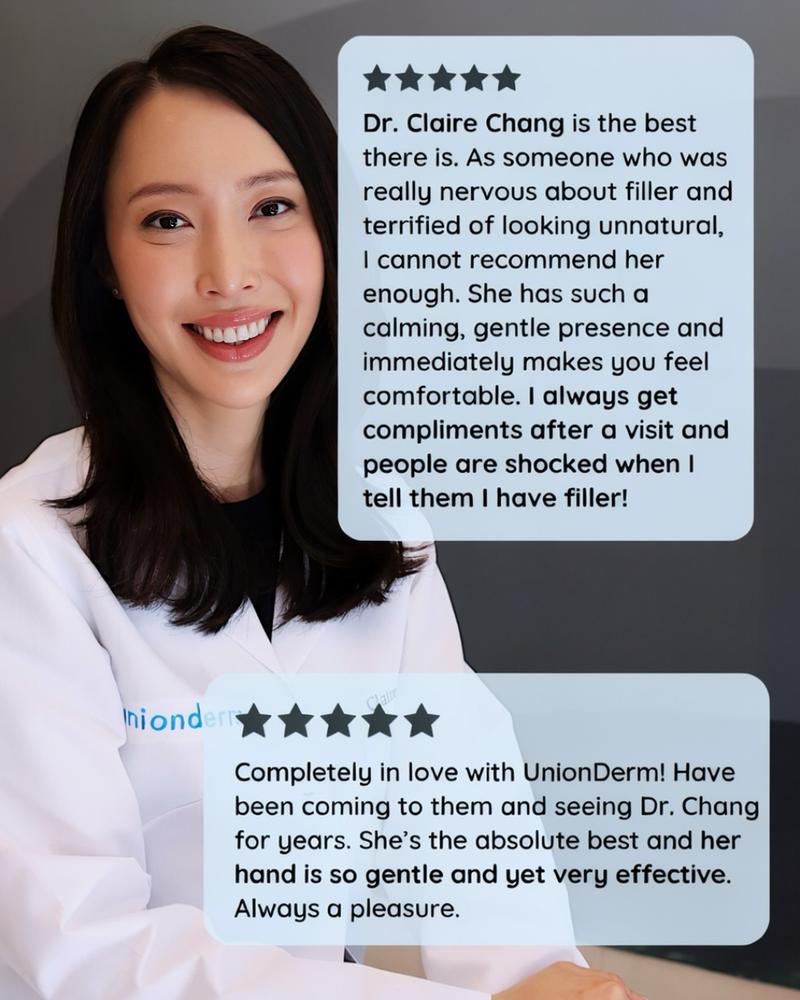
Nervous patients, gentle hands, and natural results: the words behind ten plus years of returning faces at UnionDerm.
“A decade of care. Consistently natural results. 🤍 Dr. Claire Chang has a gift for making even the most nervous patients feel completely at ease. Her hand is gentle, her approach is honest, and she takes the time to actually explain what’s happening. the science, the recovery, the realistic timeline. We could tell you why patients keep coming back for 10+ years. Instead, we’ll let their words do it. Swipe through a few of our favorites. ✨”

Hair Restoration · From your post
Two UnionDerm patients, two treatment plans, and one shared starting point: an evaluation built around what their hair loss actually needed.
“Same technology. Different treatment plans. Incredible results. Every case of hair loss is different, which is why these two UnionDerm patients received personalized treatment plans centered around Folix. Whether you’re just starting to notice thinning or have been dealing with hair loss for years, an expert evaluation is the first step toward finding the right solution. Results by Dr. Jennifer Chwalek. @yogaderm #HairRestoration #HairLossTreatment #Folix #Dermatologist”
One social post becomes another searchable entry point to UnionDerm.
Our own magazine. Clicks and citations from Google Search Console, as of September 15, 2026.
Draft story for unionderm.com · Team News
A year of training in injectables, lasers, and regenerative aesthetics ends with a celebration dinner and a new title.
Last week we gathered around a table to celebrate a milestone a year in the making. Dr. Victoria Humphrey completed the ASDS Cosmetic Dermatologic Surgery Fellowship at UnionDerm, and the team marked it the way we mark things that matter here, with a dinner in her honor, good food, and the kind of laughter that comes from actually knowing someone well.
The evening had its own tradition too, a round of Pin the Handpiece on the Humphrey, which is exactly as playful as it sounds. It is a small ritual, but it says something about how we like to close out big chapters. Achievement gets recognized seriously, then celebrated lightly, with the people who watched the work happen up close every day.
The fellowship itself asked a lot of her. Over the past year, Dr. Humphrey trained alongside leading experts across injectables, lasers, and regenerative aesthetics, learning techniques at the edge of the field while also carrying a full patient load. That combination, hands on clinical work paired with active research contribution, is what shapes a physician who can move between the study and the treatment room with equal comfort.
Contributing to clinical research while still seeing patients is not a small balancing act. It means testing new understanding against real cases, and bringing patient experience back into the research conversation. That loop, between what is being studied and what is actually happening in front of a patient, is part of what a fellowship like this is designed to build, and it is the foundation she now carries into daily practice.
With the fellowship behind her, Dr. Humphrey now steps in as an attending physician, and we are proud to have her lead our Greenwich office. It is a meaningful shift, from trainee to the person setting the tone for a location, responsible not just for individual patients but for the standard of care that an entire office reflects day to day.
Her practice will not stay confined to one address. She will also see patients on select days at Union Square and at Central Park, giving patients across those neighborhoods access to the same physician and the same year of specialized training. For a practice with multiple locations, that kind of continuity matters, letting expertise travel to where patients already are.
What stood out that night was not just the fellowship certificate or the new title, it was watching a full room recognize how much work sat behind both. A year of training, research, and patient care does not announce itself loudly day to day. It shows up quietly, appointment by appointment, until suddenly there is a dinner, a toast, and a new attending physician standing at the front of it.
Dr. Humphrey now brings that year of training directly into rooms with patients across Greenwich, Union Square, and Central Park. The handpiece game may have been the lighter part of the evening, but the seriousness underneath it was real, a physician who spent a year sharpening her craft is now practicing it, in person, across the offices that make up UnionDerm.
Draft story for unionderm.com · Patient Care
Nervous patients, gentle hands, and natural results: the words behind ten plus years of returning faces at UnionDerm.
A patient walks in nervous about filler and terrified of looking unnatural. That fear is common, and it is exactly the starting point Dr Claire Chang works from with every new face in her chair. Rather than rushing past that anxiety, she treats it as the first and most important part of the conversation before any needle comes near the skin.
The reviews we keep hearing describe the same thing in different words: a calming presence, a gentle hand, an approach that feels honest rather than salesy. One patient wrote that she cannot recommend Dr Chang enough after arriving terrified and leaving comfortable. Another has been coming back for years and still calls her hand gentle and yet very effective.
What separates a good injector from a forgettable one often comes down to what happens before the treatment starts. Dr Chang takes the time to actually explain what is happening: the science behind the product, what recovery looks like day by day, and a realistic timeline for when results settle in. Patients are not left guessing.
That explanation matters most for someone who has never had filler before and does not know what normal swelling looks like versus something worth calling about. Removing that uncertainty is part of the treatment itself. A patient who understands the process tends to trust the outcome more, even before they see it fully settle in the mirror.
The compliment we hear repeated most is a strange one to receive after cosmetic work: people are shocked when a patient tells them she has filler. That reaction is the actual goal. The work is meant to be noticed as a person looking well rested and like themselves, not as a visibly altered face that announces the appointment.
Achieving that requires restraint as much as skill. Natural results come from knowing where to stop, not just where to place product. It is a quieter kind of expertise, one that shows up in how often people ask what changed without being able to name it, rather than in dramatic before and after transformations.
Some of the reviews we are sharing come from patients who have been seeing Dr Chang for years, not for a single appointment. That kind of repeat relationship says something different than a first impression can. It means the calm, the honesty, and the gentle hand held up appointment after appointment, not just on the day someone was nervous and needed reassurance.
We could describe why that consistency matters, but their own words do it better than we can. A decade of care shows up in the small details patients mention: feeling at ease, getting compliments afterward, trusting the process enough to return. That is the pattern behind the five star reviews, told the way patients actually tell it.
Draft story for unionderm.com · Hair Restoration
Two UnionDerm patients, two treatment plans, and one shared starting point: an evaluation built around what their hair loss actually needed.
A view of the crown tells you more than a mirror ever will. That is the angle these results are shown from: hair parted back, scalp visible, the same overhead framing used before and after two Folix treatments. One month apart, the difference in density along the crown and hairline is visible without needing anyone to point it out.
What makes this pairing useful is that it is not one result held up as proof. It is two patients, treated at the same practice with the same underlying technology, whose plans still looked different from each other. Hair loss does not follow a single pattern, so treating it well rarely means applying a single protocol regardless of who is sitting in the chair.
One of the patients shown here had already been through finasteride and topical minoxidil before coming in. Those are common first steps, and they work for some people. This patient wanted more improvement than that combination was providing, which is a familiar place to be: doing the standard things and still watching thinning continue in the same spots.
Folix is the shared foundation in both cases, but a shared foundation is not the same as a shared plan. The concentration, the application routine, and what it gets paired with can all shift based on how advanced the thinning is, where it is concentrated, and what a patient has already tried. That is the actual work of an evaluation, not just confirming that treatment is warranted.
We also draw a real distinction between someone just starting to notice thinning and someone who has been dealing with hair loss for years. Both are valid entry points, but they are not the same problem. Someone catching early thinning is often working with more follicles still capable of responding. Someone years in may need a plan built around a different set of expectations.
In the after image, the part line is narrower and the scalp shows through less along the crown, particularly toward the center where the before image shows the most visible thinning. Nothing here is presented as a finished result. One month is early, and the treatment plan is ongoing, which is part of why it is worth showing progress at this stage rather than waiting for a longer timeline.
Results here are credited to Dr. Jennifer Chwalek, and the throughline across both cases is that the treatment plan came after a real look at the patient's hair loss, not before it. That sequencing matters more than any single product name. Folix is the tool, but the plan around it is what determines whether someone sees change like this at one month or something slower and different.
If there is one practical takeaway in placing these two cases side by side, it is that comparing your own hair loss to someone else's timeline is less useful than getting your own evaluated. What worked over one month for a patient already past finasteride and minoxidil is not a guarantee for someone earlier in the process. It is a starting point for a conversation, not a substitute for one.
Keep reading