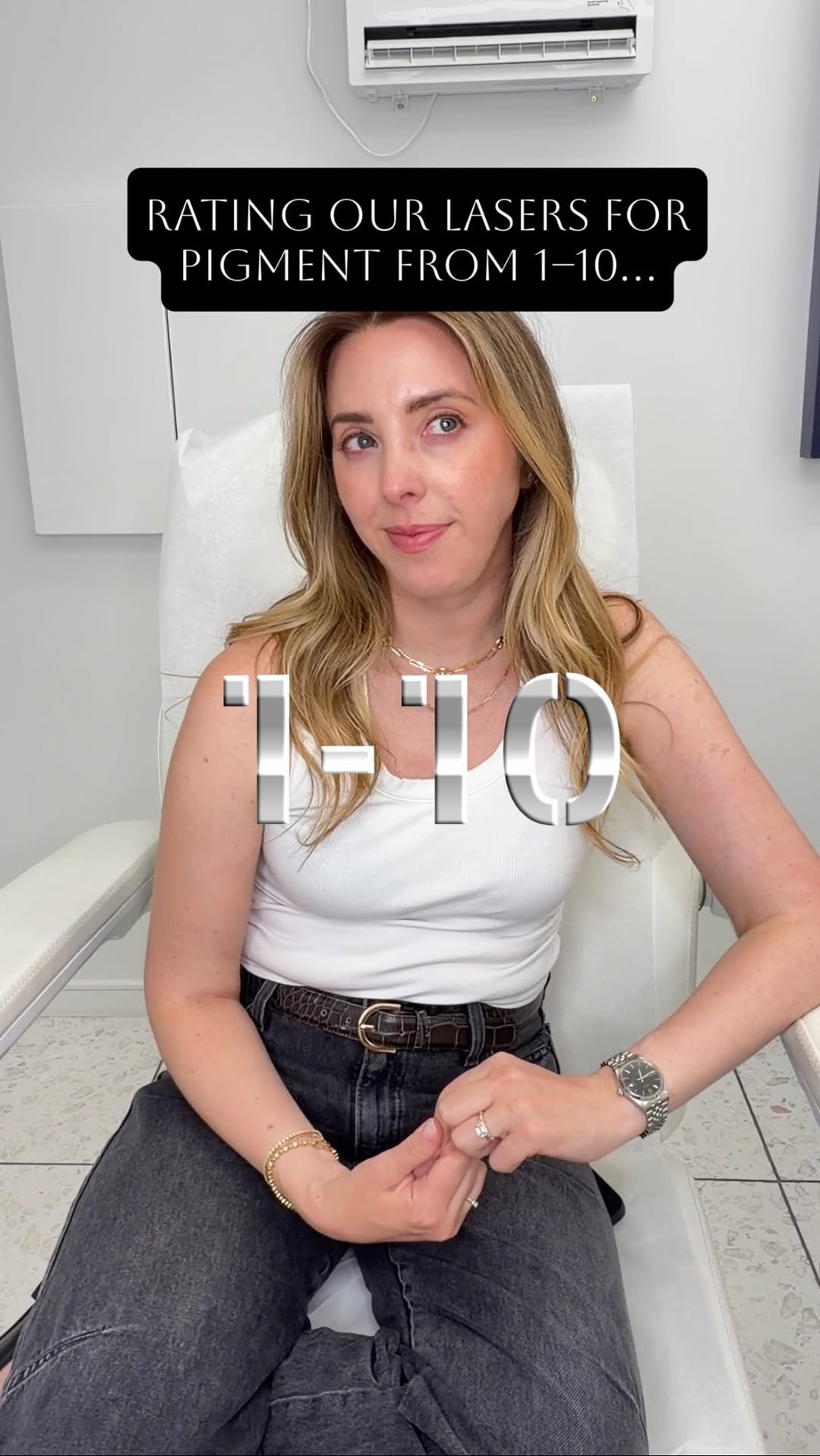
Why the best pigment laser is not always the highest rated one
Rating lasers from one to ten is easy. Matching the right one to your skin is the actual work.
SKIN SOLUTIONS COLLECTIVE STAFFTurn your social into search
We turn your posts into editorial stories that bring new search traffic to skinsolutions.co. Three of yours will be on this page.
Book a demo
skinsolutions.co Not all pigment is created equal. and neither are the lasers we use to treat it. Some lasers are better for subtle brightening and maintenance. Others are designed to target visible sun damage and brown spots. And some work by resurfacing the skin to improve pigment along with texture, tone and overall skin quality. So while we can rate them from 1. 10, the real answer is a little more nuanced. The “best” laser depends on what kind of pigment we’re treating, your skin type, how deep the pigment sits, and what else we want to improve at the same time. Because a 9/10 laser isn’t necessarily a 9/10 laser for you. Melissa Knudson @nursemelnyc 📲 212 417/0002 to book a consult with Nurse Mel. #linkinbio to book with Nurse Mel online. #lasers #pigment #sunspots
Rating lasers from one to ten is easy. Matching the right one to your skin is the actual work.
SKIN SOLUTIONS COLLECTIVE STAFFHow it works
Same as today. Nothing changes on Instagram.
We turn your post into a full story in your voice within the hour.
One click publishes it to skinsolutions.co. Nothing goes live without you.
Your stories
Nothing was published anywhere. You decide that. Every word will come from your own posts, your own photos and your own treatments.
Pigment Treatment · From your post
Rating lasers from one to ten is easy. Matching the right one to your skin is the actual work.
“Not all pigment is created equal. and neither are the lasers we use to treat it. Some lasers are better for subtle brightening and maintenance. Others are designed to target visible sun damage and brown spots. And some work by resurfacing the skin to improve pigment along with texture, tone and overall skin quality. So while we can rate them from 1. 10, the real answer is a little more nuanced. The “best” laser depends on what kind of pigment we’re treating, your skin type, how deep the pigment sits, and what else we want to improve at the same time. Because a 9/10 laser isn’t necessarily a 9/10 laser for you. Melissa Knudson @nursemelnyc 📲 212 417/0002 to book a consult with Nurse Mel. #linkinbio to book with Nurse Mel online. #lasers #pigment #sunspots”
Skin Notes · From your post
Diana Palmisano walks through why Botox, Skinvive, and resurfacing sometimes solve lip line concerns better than filler alone.
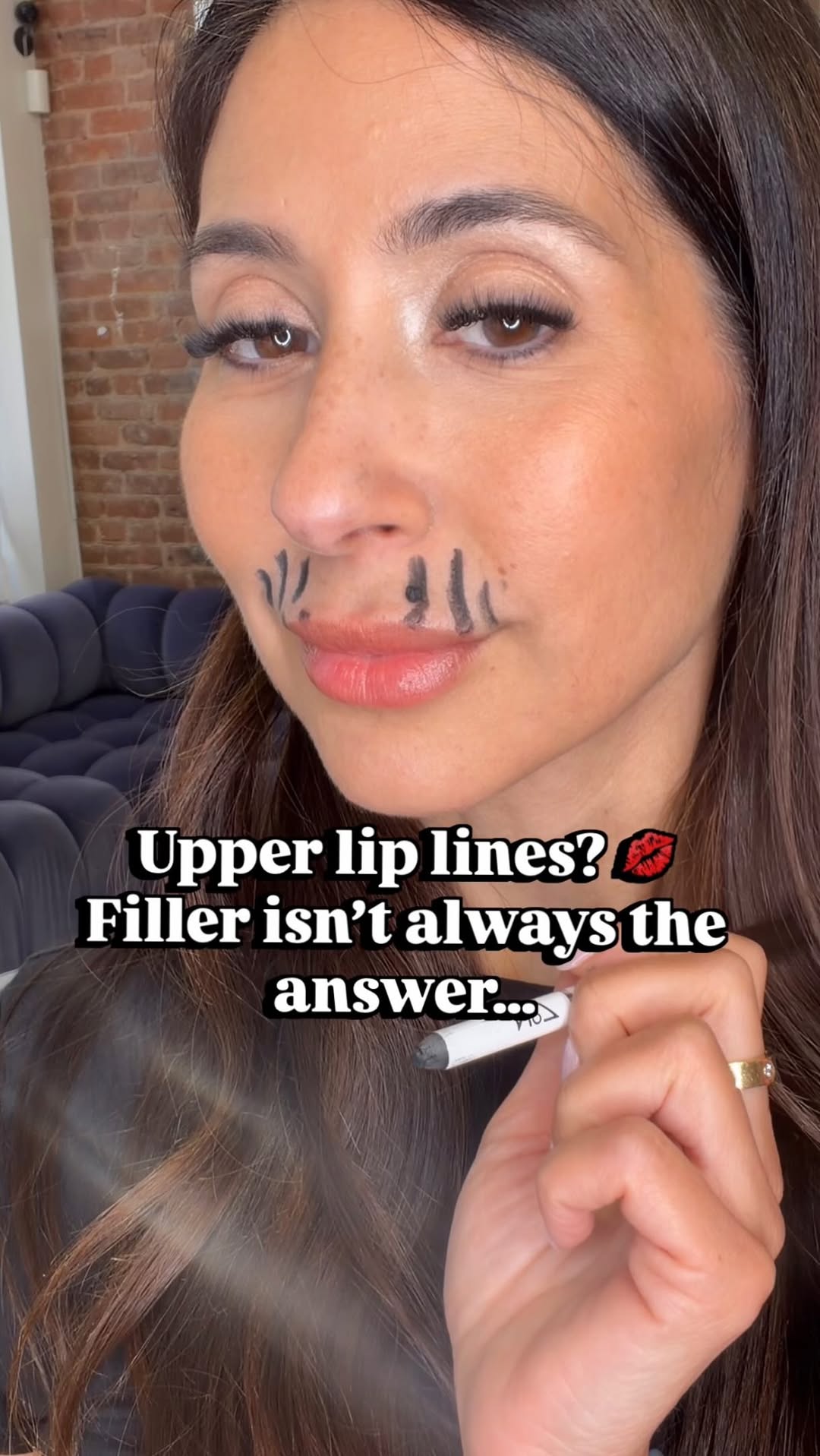
“Not every upper lip line needs filler. 💋 For this area, two of Diana’s favorite injectable options are Botox + Skinvive because they address two different pieces of the problem. Botox can help soften the repetitive muscle movement that contributes to vertical lip lines, while Skinvive improves hydration and skin quality without adding traditional filler like volume. And injectables aren’t the only option. Resurfacing treatments such as CO2 laser can also be incredibly helpful for improving etched in lines, texture and overall skin quality around the mouth. Diana Palmisano | @dermduo 📲 212 787 6970 to book a complimentary consultation with Diana Palmisano. 💻 #linkinmybio to book a complimentary consultation with Diana online. #smokerslines #liplines #skinvive #botoxlips”
Treatment Notes · From your post
Tension in the shoulders is a muscle problem, and TrapTox treats it exactly like one.
“Ever notice tension creeping up your shoulders? That’s your traps working overtime. TrapTox helps relax those overactive muscles. easing tension, improving posture, and creating a softer, elongated neck line. 💆♀️ Laura Palmisano | @dermduo 📲 212 787 6970 to book an appointment with Laura Palmisano. Follow along for more info on Traptox! #traptox #barbietox #traps #aesthetic #nyctraptox”
One social post becomes another searchable entry point to Skin Solutions Collective.
Our own magazine. Clicks and citations from Google Search Console, as of September 15, 2026.
Draft story for skinsolutions.co · Pigment Treatment
Rating lasers from one to ten is easy. Matching the right one to your skin is the actual work.
We get asked constantly which laser is the best for pigment, as if there is one universal answer that applies to every face that walks through our doors. There isn't. Pigment shows up differently from person to person, and the tools we use to treat it are built with different jobs in mind. A rating system is a fun place to start, but it is not where the real answer lives.
Some of our lasers are built for subtle brightening and ongoing maintenance, the kind of treatment that keeps tone even without asking much recovery time of you. They are not trying to erase deep damage in one pass. They are doing quieter, steadier work, which is exactly what certain skin needs and exactly what other skin does not.
Other lasers in our rooms are built for visible sun damage and brown spots that have been sitting there for years, the kind that catch light differently than the rest of the skin. These are more targeted, more assertive tools, and they tend to score higher on paper. But a high score only means the laser is powerful. It does not mean it is the right match for every patient sitting in the chair.
Then there are the lasers that work by resurfacing, treating pigment as one part of a bigger picture that includes texture, tone and overall skin quality. These tend to ask more of you in terms of downtime, but they are solving more than one problem at once. Rating that kind of tool on a single scale for a single concern misses most of what it is actually built to do.
So when we rate our lasers from one to ten for pigment, we mean it, but we also mean it with an asterisk. The real answer depends on what kind of pigment we are treating, what your skin type is, how deep that pigment actually sits, and whether we are also trying to improve something else while we are in there. A 9 out of 10 laser is only a 9 out of 10 for the right person.
This is the part that does not translate well into a quick caption or a graphic with a number on it. Two patients can walk in with pigment that looks nearly identical to the eye and walk out with two completely different treatment plans, because what is happening underneath the surface is not the same. That distinction is the entire point of a consult in the first place.
Nurse Mel handles these consults directly, working through what kind of pigment is present, how your skin tends to respond, and what combination of goals we are actually trying to hit before any laser gets chosen. It is less about picking the top rated device and more about ruling out the ones that are not built for your particular situation.
If pigment is something you have been trying to figure out on your own, the fastest way to get a straight answer is to sit down with Nurse Mel and let her look at what is actually there. You can call 212 417 0002 to book a consult, or use the link in our bio to book with Nurse Mel online whenever works for you.
Draft story for skinsolutions.co · Skin Notes
Diana Palmisano walks through why Botox, Skinvive, and resurfacing sometimes solve lip line concerns better than filler alone.
Upper lip lines get treated like a single problem with a single fix, and filler is usually the first thing people ask for. But the fine vertical lines that show up above the lip are not always a volume issue. Sometimes the real drivers are repetitive muscle movement and the quality of the skin itself, which is why the answer is not always more filler.
Diana Palmisano works through this distinction often, and two of her preferred options for this area are Botox and Skinvive, used because they address two separate pieces of the same concern rather than one blanket solution. Neither is aimed at adding the kind of volume traditional filler provides, which is part of why they get overlooked when people are focused only on smoothing lines fast.
Botox works on the muscle side of the equation. The vertical lines above the lip are often linked to repetitive movement in that area, and softening that movement can reduce how deeply those lines show up over time. It is a targeted approach aimed at the behavior causing the line, not at filling the line itself once it has already formed on the surface.
Skinvive takes a different route entirely. Rather than adding structure or volume, it is used to improve hydration and overall skin quality in the area, which matters because thinner, drier skin tends to show fine lines more sharply. Pairing the two means addressing the muscle activity and the skin's condition at the same time, instead of relying on one treatment to do both jobs.
Injectables are not the only path forward, and for some patients they are not even the most effective one. Lines that are more etched in, along with texture changes around the mouth, often respond well to resurfacing treatments. CO2 laser is one option Diana points to for this, since it works directly on the surface quality of the skin rather than the muscle or hydration layer beneath it.
The point is not that one treatment beats another across the board. It is that the mouth area can show aging in more than one way at once, muscle movement, hydration, and surface texture, and each of those calls for a different tool. Treating all upper lip lines the same way, with the same product, tends to miss at least one part of the picture.
That is why this conversation usually starts with a consultation rather than a treatment plan already decided in advance. Diana looks at what is actually driving the lines for that specific patient before recommending Botox, Skinvive, resurfacing, or some combination of the three, since the right approach depends on what is happening in the skin and muscle, not on which treatment is most requested.
Anyone dealing with upper lip lines and unsure which category their concern falls into can book a complimentary consultation with Diana Palmisano directly. It is a low pressure way to get a clear read on whether the issue is muscle movement, skin quality, texture, or some mix of the three, before committing to any single treatment path.
Draft story for skinsolutions.co · Treatment Notes
Tension in the shoulders is a muscle problem, and TrapTox treats it exactly like one.
Most people carry their stress somewhere specific, and for a lot of our patients that place is the trapezius. It is the muscle that runs from the base of the skull across the shoulders, and it tends to work overtime without anyone noticing until the tension has settled in for good. TrapTox starts from that simple observation: the traps are overworked, and overworked muscles respond to relaxation.
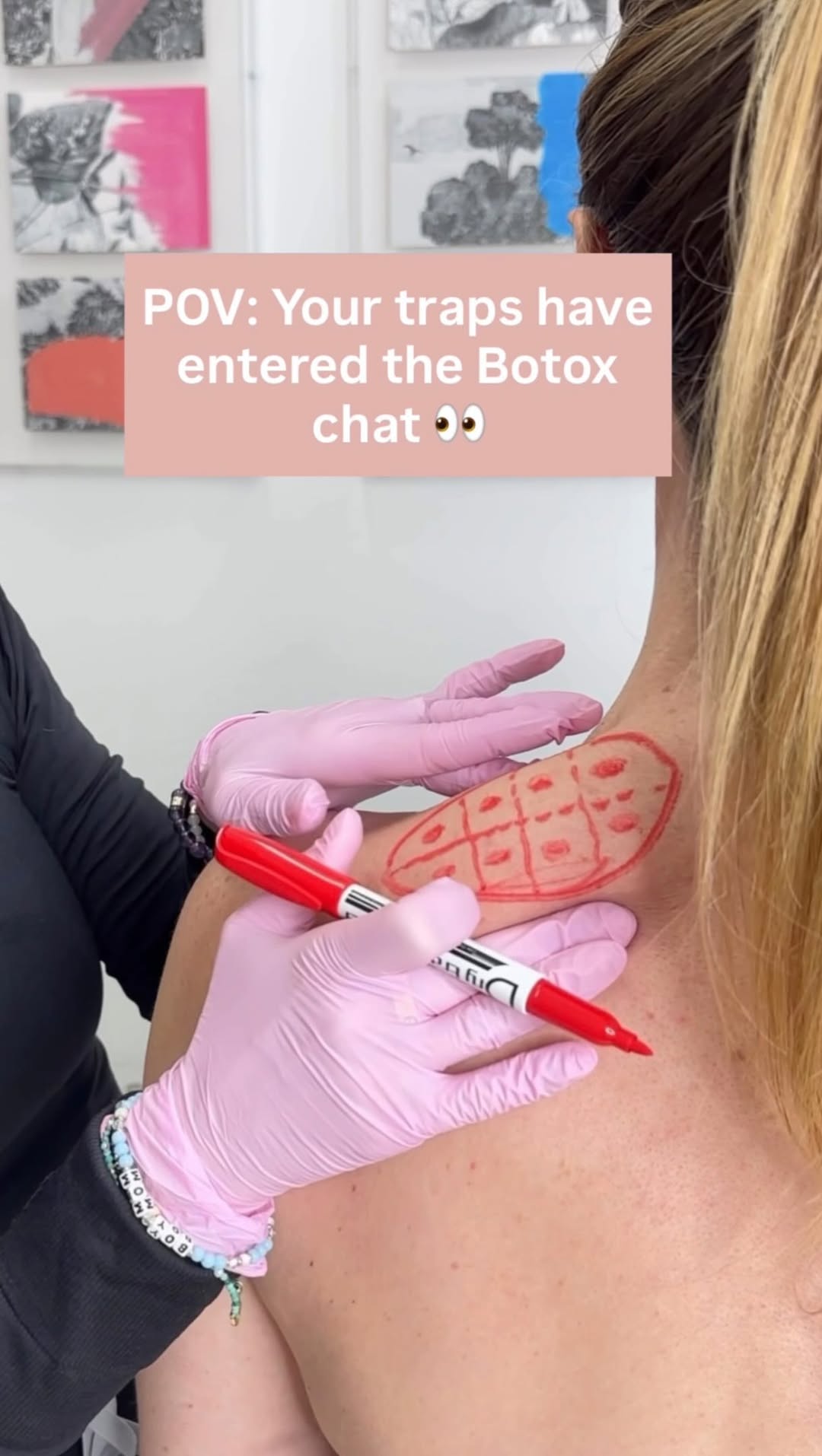
The marking on the shoulder tells you exactly how deliberate this is. A grid of small red dots covers the trapezius in an even, mapped out pattern, each one a planned injection point rather than a guess. Laura Palmisano draws it directly onto the skin before treatment begins, which keeps the dosing even across the whole muscle instead of concentrated in one spot.
The traps do a lot of quiet, constant work. They stabilize the shoulders, support the neck, and react to stress by tightening, often without a person consciously clenching anything. Over time that low grade tension can pull the shoulders up and forward, which shortens the look of the neck and keeps the muscle in a near constant state of contraction that never fully releases on its own.
TrapTox works by easing that overactivity. When the muscle relaxes, the tension it was holding starts to release along with it, which is where patients tend to notice the posture change first. Shoulders sit lower, the neck reads longer, and the whole upper back looks less braced. It is a small shift, but it is one people feel before they can fully explain why.
That checkerboard of marks is not decorative, it is the treatment plan made visible. Spacing the injection points evenly across the trapezius means the muscle relaxes as a whole rather than in isolated patches, which is what gives the results their smooth, natural quality. It is a practical detail, but it is also the part of the process most patients never get to see mapped out this clearly.
Laura Palmisano treats TrapTox at Skin Solutions Collective, and she is the one who does the marking and the injections herself. If shoulder tension has become part of your daily posture, this is a straightforward way to address the muscle directly instead of just stretching around it. Appointments with Laura can be booked by calling 212 787 6970, and we are always glad to answer questions before you come in.
We keep sharing the process because the mapping step is the part people are most curious about once they see it. It demystifies what is otherwise a quick, targeted appointment. Traps carry more of our daily tension than most people realize, and treating them with the same precision as any other area of the face or body is simply an extension of how we approach the rest of our work.
Keep reading