Why we sometimes say no to lip filler
Turning down a request is not a rejection, it is how we protect a face that already works.
REWIND AESTHETICS STAFFTurn your social into search
We turn your posts into editorial stories that bring new search traffic to rewindculver.com. Three of yours will be on this page.
Book a demo
rewindaestheticsla We promise… we don’t say no to be mean!! If we say no it is because we think what you want will take away from your beauty and not add to it and we are in the business of adding to your natural beauty 💋
Turning down a request is not a rejection, it is how we protect a face that already works.
REWIND AESTHETICS STAFFHow it works
Same as today. Nothing changes on Instagram.
We turn your post into a full story in your voice within the hour.
One click publishes it to rewindculver.com. Nothing goes live without you.
Your stories
Nothing was published anywhere. You decide that. Every word will come from your own posts, your own photos and your own treatments.
Client Care · From your post
Turning down a request is not a rejection, it is how we protect a face that already works.
“We promise… we don’t say no to be mean!! If we say no it is because we think what you want will take away from your beauty and not add to it and we are in the business of adding to your natural beauty 💋”

Skin Notes · From your post
California heat sticks around past summer, and so does the question of whether your sweating is actually hyperhidrosis.
“Fall is approaching, but in California the heat isn’t going far 😏 Hyperhidrosis isn’t just a summer condition, it can be a year round issue for a lot of people! Do you think you could be one of them?”
Skin Care · From your post
Why the least glamorous part of any treatment plan is the one we bring up every single time.
“It really does feel like we are talking to a wall with the sunscreen advice sometimes 😂 But we promise it’s for your own good!”
One social post becomes another searchable entry point to Rewind Aesthetics.
Our own magazine. Clicks and citations from Google Search Console, as of September 15, 2026.
Draft story for rewindculver.com · Client Care
Turning down a request is not a rejection, it is how we protect a face that already works.
There is a moment in almost every consultation where the answer has to be no. Not because the request is unreasonable, but because saying yes would take something away rather than add to it. That distinction is the whole job. Anyone can inject filler. Deciding when not to is the part that actually requires judgment, and it is the part we take seriously every time.
We are not saying no to be difficult. We say it because we think about a face as a whole, not as a single feature waiting to be enlarged. Lips do not exist on their own. They sit inside proportion, balance, and whatever already makes a person look like themselves. When a request would disrupt that balance, the kind thing to do is explain why, not simply comply.
Our line is simple: we are in the business of adding to natural beauty, not replacing it. That means every conversation starts with what is already there. We look at structure, symmetry, and the face at rest before we talk about volume. If more filler would flatten those natural lines instead of complementing them, that is worth saying out loud before anything else happens.
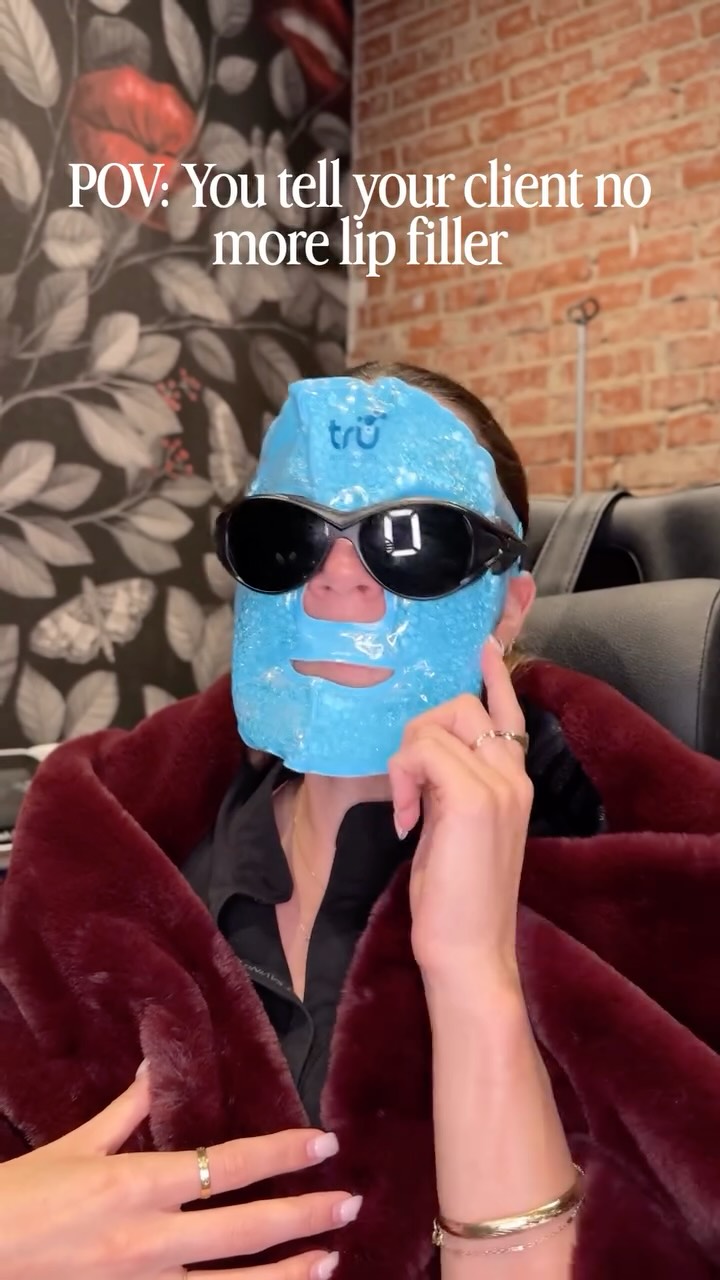
After a treatment, the real work is patience, not activity. A cold, textured mask covers the lower half of the face, sealed to bring down swelling and calm the skin underneath. Sunglasses go on next, both to shield sensitive eyes and to give a client permission to simply sit still. It is quiet, deliberate, and very unglamorous compared to what people usually imagine.
Wrapped in a heavy burgundy throw, settled into a leather chair, there is nowhere to be and nothing to perform. That stillness is part of the process. Swelling needs time to settle before anyone, client or provider, can accurately judge the result. Rushing that step is how good work gets second guessed too early, before the face has had the chance to actually reveal itself.
The mask itself is almost theatrical, bright blue, cut with openings at the eyes and mouth, cooling the skin evenly across the cheeks and jaw. It looks a little absurd, and we know it. But underneath the humor is a genuinely practical tool, reducing inflammation so the final shape settles the way it was planned rather than the way swelling temporarily suggests it might.
Turning down a request is not about control. It is about trusting that a client came to us wanting to look like a better version of themselves, not a different person entirely. When we say no, we are asking for a beat of trust in return, the same trust that lets someone lie back under a cooling mask and let the process do its work without interference.
That is the trade we are offering. We will always tell you what we actually think, even when it is not the answer you walked in expecting. In exchange, you get a result built around your own features instead of a trend. The mask comes off, the swelling goes down, and what is left underneath still looks unmistakably like you, just a little more like your best version.
Draft story for rewindculver.com · Skin Notes
California heat sticks around past summer, and so does the question of whether your sweating is actually hyperhidrosis.
Fall is technically here, but the heat has not gotten the memo, and neither has the sweating some of our clients have been dealing with since June. It is a familiar pattern in Culver City. The calendar changes, the temperature barely does, and the question we keep hearing stays the same: is this just warm weather, or is something else going on?
That question is worth asking honestly. Sweating is a normal, necessary function. It cools the body down and it happens to everyone, regardless of season. But there is a difference between sweating because it is genuinely hot outside and sweating that shows up regardless of temperature, activity level, or how mild the day actually turned out to be.
Hyperhidrosis is the term for that second pattern. It describes sweating that goes beyond what the body needs for regulation, and it does not clock out when summer ends. For a lot of people it is a year round experience, not a seasonal one, which means the arrival of fall does not automatically bring relief the way it might for someone whose sweating really was just heat related.
That distinction matters because it changes how someone should think about what they are dealing with. If sweating eases up once the temperature drops, that is one story. If it does not, if it shows up in cool rooms, during ordinary tasks, or at times that have nothing to do with heat or exertion, that is a different story entirely, and it is the one worth paying attention to.
We bring this up now because fall is exactly the moment that pattern becomes obvious. Summer gives everyone an easy explanation for sweating more. Once the weather cools and the sweating does not follow, the excuse disappears, and what is left is a clearer picture of what is actually happening with a person's body on a day to day basis.
It is worth sitting with the question honestly rather than assuming one way or the other. Does the sweating track with temperature and activity, or does it seem to have a logic of its own? Has it been a summer thing in past years too, or is this the first fall it has stuck around? Small observations like these tend to say more than a single hot afternoon ever could.
None of this is about alarm, it is about accuracy. Sweating more than expected does not automatically mean anything serious, but it also is not something to wave off simply because the season is changing. If the pattern feels familiar, ongoing, and disconnected from the actual weather, it is a reasonable thing to bring up and have looked at directly.
That is really the point of raising it as fall settles in. California is not going to hand anyone a clean seasonal reset when it comes to heat, and the body does not always follow the calendar either. If the sweating has outlasted summer before, or seems to be doing it again this year, it is worth treating as its own question rather than a leftover one.
Draft story for rewindculver.com · Skin Care
Why the least glamorous part of any treatment plan is the one we bring up every single time.
There is a particular moment in almost every appointment at Rewind Aesthetics when the conversation turns away from the treatment itself and toward something far less exciting: sunscreen. We bring it up gently at first, then more directly, because we know how easy it is for clients to nod along and quietly file the advice away as optional. It rarely is.
We have started joking that giving sunscreen advice sometimes feels like talking to a wall, the kind of good natured frustration that comes from caring about an outcome more than the person in front of you realizes you do. It is not nagging for the sake of it. It is the part of the visit that determines whether everything else we just did actually holds up over time.
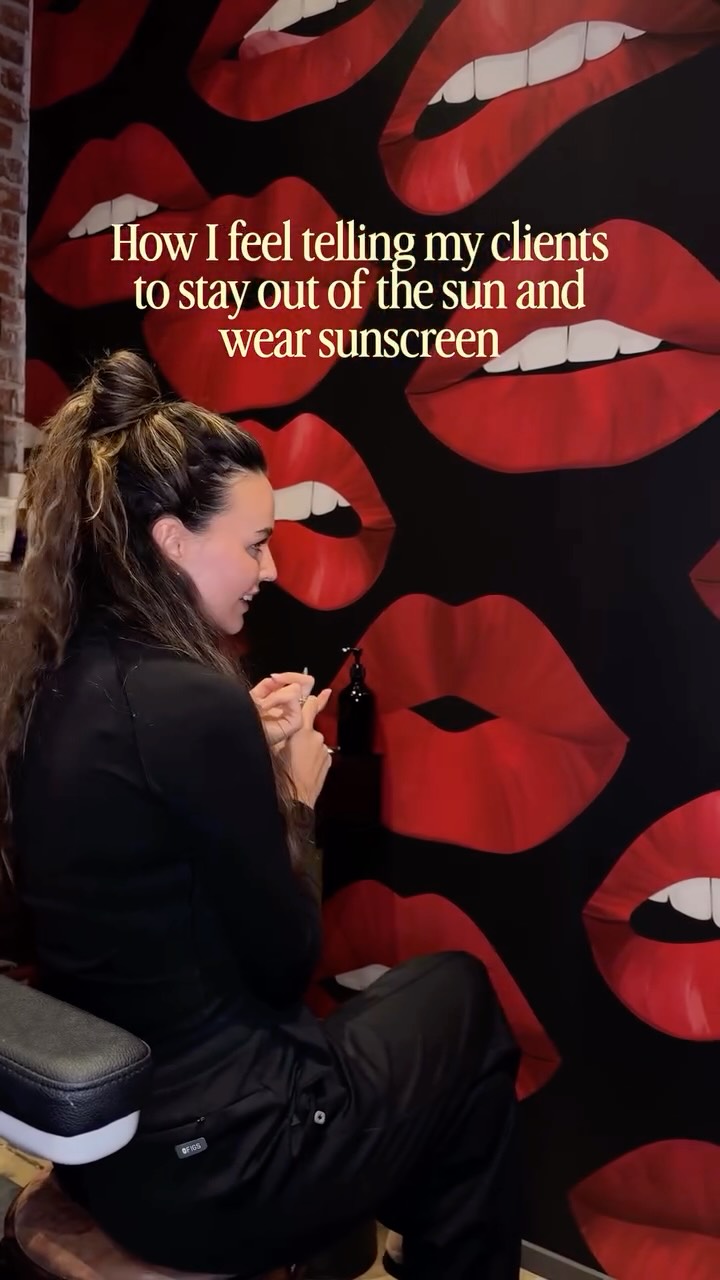
Sitting against a wall covered in bold red lips, repeating the same reminder about staying out of direct sun, is a strange kind of ritual. The advice does not change from client to client. Stay covered. Reapply. Give your skin the chance to actually heal without added stress. It sounds simple because it is, but simple does not always mean easy to follow once someone leaves the chair.
Aesthetic treatments ask skin to do real work, whether that is calming inflammation, rebuilding texture, or simply recovering from being handled and treated at all. Sun exposure interferes with that process in ways that are not always visible right away. That delay is part of the problem. A client can leave feeling fine, skip the sunscreen once, and not notice the consequence until weeks later.
So we repeat ourselves, because repetition is often the only thing that actually works. We would rather say the same sentence in five different appointments than have a client wonder later why results faded faster than expected. It is not about being right. It is about protecting the time, money, and trust someone puts into a treatment plan they chose specifically because they wanted to see it through.
Sunscreen does not feel like part of the treatment because it happens after the appointment, away from us, in ordinary daily life. That is exactly why it matters so much. The work we do in the chair is only one half of the equation. What happens on the drive home, the walk to lunch, or the errand run in bright afternoon light is the other half, and it is entirely in the client's hands.
We are not trying to make anyone paranoid about the sun. We are trying to make sunscreen feel less like an afterthought and more like a habit that belongs right alongside the rest of a skincare routine. Once it becomes automatic, the conversation gets a lot shorter, and we get to spend more of the appointment talking about progress instead of prevention.
So yes, we will keep bringing it up, even when it starts to sound like a broken record from across the room. Some advice is worth repeating precisely because it is easy to ignore in the moment and costly to ignore over time. If it ever starts to feel like we are talking to a wall, take it as a sign that we simply have not stopped caring about how your skin looks next month, not just today.
Keep reading