
What I would tell my twenty something self about skin
A look back at the skincare habits that mattered less than sunscreen and consistency actually did.
MONICA KIEU, DO FACS STAFFTurn your social into search
We turn your posts into editorial stories that bring new search traffic to drmonicakieu.com. Three of yours will be on this page.
Book a demo
drmonicakieu My biggest skincare mistake in my 20’s is that I basically had NO skincare routine. 😬 I didn’t think much about prevention, I wasn’t consistent with sunscreen, and I definitely didn’t understand how much the habits I developed then would affect my skin later. If I could go back, I’d do things differently. ☀️ Wear sunscreen every single day 🧴 Establish a simple, consistent skincare routine 🧬 Start thinking about prevention instead of waiting until I saw signs of aging You don’t need a complicated 10 step routine in your 20s. But I wouldn’t recommend doing nothing either. Sharing everything I know now, so you don’t make the same mistakes I did! Let me know your other questions in the comments! #drkieutips #skincare #skincareroutine #spf
A look back at the skincare habits that mattered less than sunscreen and consistency actually did.
MONICA KIEU, DO FACS STAFFHow it works
Same as today. Nothing changes on Instagram.
We turn your post into a full story in your voice within the hour.
One click publishes it to drmonicakieu.com. Nothing goes live without you.
Your stories
Nothing was published anywhere. You decide that. Every word will come from your own posts, your own photos and your own treatments.
Skincare Wisdom · From your post
A look back at the skincare habits that mattered less than sunscreen and consistency actually did.
“My biggest skincare mistake in my 20’s is that I basically had NO skincare routine. 😬 I didn’t think much about prevention, I wasn’t consistent with sunscreen, and I definitely didn’t understand how much the habits I developed then would affect my skin later. If I could go back, I’d do things differently. ☀️ Wear sunscreen every single day 🧴 Establish a simple, consistent skincare routine 🧬 Start thinking about prevention instead of waiting until I saw signs of aging You don’t need a complicated 10 step routine in your 20s. But I wouldn’t recommend doing nothing either. Sharing everything I know now, so you don’t make the same mistakes I did! Let me know your other questions in the comments! #drkieutips #skincare #skincareroutine #spf”

Recovery Notes · From your post
What happens after facial plastic surgery shapes the final result as much as the procedure itself.
“I can do everything right in the operating room… then your job starts when you leave ❤️🩹 Following your post op instructions isn’t optional. How you sleep, clean your incisions, manage swelling, wear your compression, limit activity, and show up for follow ups can all affect your healing and final result. And please don’t substitute TikTok, Reddit, or your friend’s experience for the instructions your surgeon gave you. Your recovery plan is specific to your surgery and your body. The surgery is only part of the journey. Protect the investment you made in yourself by taking your recovery seriously. 🤍 #drkieutips #SurgeryRecovery #PostOpCare #FaceliftRecovery #RhinoplastyRecovery”
Behind The Mask · From your post
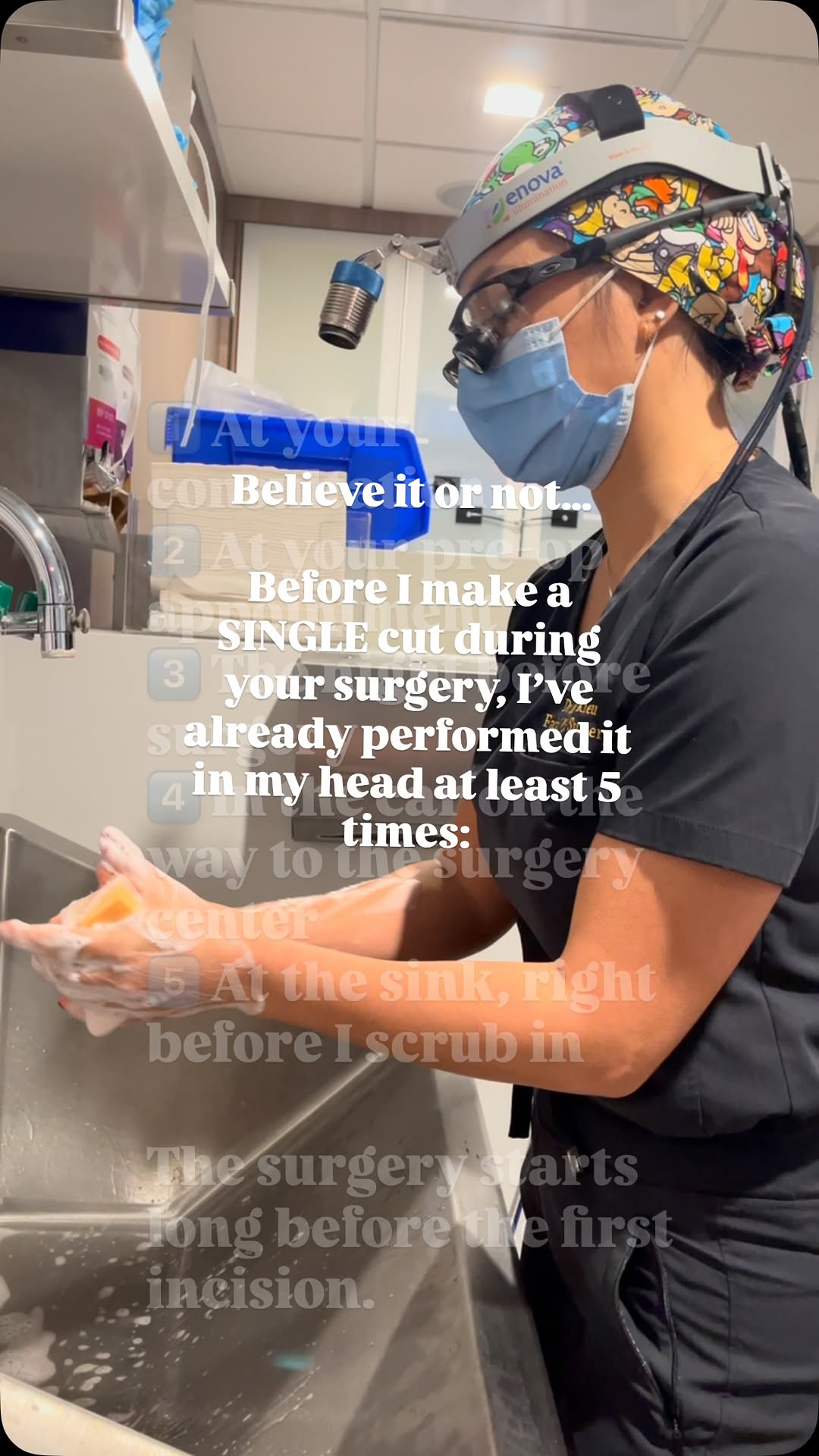
Scrubbing in at the sink is the last of several mental rehearsals that happen long before the first cut.
“By the time you’re on my operating table, I’ve already spent countless hours thinking about you, your surgery, and how to give you the best possible result. Every detail has been thought through. I don’t take that trust lightly. ❤️”
One social post becomes another searchable entry point to Monica Kieu, Do Facs.
Our own magazine. Clicks and citations from Google Search Console, as of September 15, 2026.
Draft story for drmonicakieu.com · Skincare Wisdom
A look back at the skincare habits that mattered less than sunscreen and consistency actually did.
My biggest skincare mistake in my twenties was simple. I basically had no routine at all. I wasn't thinking about prevention, I wasn't consistent with sunscreen, and I had no real sense of how the habits I built then would show up on my skin years later. It felt like something to deal with eventually, not something to start early.
That mindset is common, and it's also the one thing I'd go back and change if I could. Not because the twenties require an elaborate routine, but because the habits formed during that decade quietly set the terms for everything that follows. Skin doesn't announce the cost of neglect right away. It waits.
If I could redo those years, three things would top the list. Wearing sunscreen every single day, without exception, regardless of plans or weather. Establishing a routine that was simple enough to actually stick to, rather than something elaborate I'd abandon within a month. And shifting my thinking toward prevention instead of waiting until visible signs of aging showed up in the mirror.
None of those three things are complicated on their own. Sunscreen is one step. A basic routine might be two or three products used consistently. Prevention is more of a mindset shift than a purchase. But together, they represent a completely different relationship with your skin than the one I had, which was mostly no relationship at all.
You don't need a ten step routine in your twenties. I want to be clear about that, because it's easy to swing too far in the other direction and assume more products mean more protection. That's not really how it works. What matters more is consistency with the basics, done daily, without skipping the parts that feel unnecessary in the moment.
But doing nothing isn't the answer either, and that's the mistake I actually made. There's a middle path between an overwhelming regimen and total neglect, and it's the one worth finding early. A few consistent habits practiced for years will do more for your skin than an expensive routine started too late and abandoned just as quickly.
Part of why I talk about this openly is because I see the long term effects of these choices every day in my work. The patients who started early tend to have an easier time maintaining their skin later. The ones who didn't often wish someone had told them sooner what actually mattered and what didn't.
So consider this that reminder, a few years earlier than I got it myself. Wear sunscreen daily. Keep your routine simple enough to actually follow. Start thinking about prevention now instead of later. Small habits, repeated consistently, tend to outperform anything complicated that only lasts a few weeks before it quietly disappears.
Draft story for drmonicakieu.com · Recovery Notes
What happens after facial plastic surgery shapes the final result as much as the procedure itself.
We can control almost everything that happens during surgery. The incisions, the technique, the precision of it all sits in our hands for those hours. But the moment a patient leaves our office, the responsibility shifts. What happens next, how the body is treated over the following days and weeks, becomes just as important to the outcome as anything that happened on the table.
Following post op instructions is not a suggestion. It is not something to adjust based on how good someone feels on a given day. Sleep position, incision cleaning, swelling management, compression wear, and activity limits are all specific for a reason. Each one plays a role in how tissue heals, how scars settle, and how close the final result comes to what was actually planned in surgery.
One of the more common mistakes we see comes from good intentions. Patients search for reassurance or shortcuts online, or they lean on what a friend experienced after a similar procedure. TikTok videos, Reddit threads, and secondhand stories were not written for their body or their surgery. What worked for someone else's facelift or rhinoplasty recovery may not apply at all to theirs.
A recovery plan is written for one person. It accounts for the specific technique used, the extent of the surgery, and how that individual's body tends to heal. Two patients who had similar procedures can still need different timelines for activity, different compression schedules, or different guidance on when swelling should start improving. There is no universal recovery template that safely replaces personalized instructions.
Showing up for follow up visits matters as much as anything done at home. These appointments let us track healing in real time, catch anything unusual early, and adjust guidance if a patient's recovery is moving faster or slower than expected. Skipping them, or treating them as optional once someone feels fine, removes a layer of oversight that is built into the recovery process for a reason.
Compression garments, in particular, tend to get abandoned early once swelling looks better than expected. But visible improvement on the outside does not always match what is still settling underneath. Wearing compression for the full recommended period, sleeping in the position advised, and limiting strenuous activity even when energy returns are all details that protect the work already done, not extra steps to rush through.
Surgery is a significant decision, and it takes real commitment to get to the operating room in the first place. That commitment does not end once the procedure is over. The weeks that follow are where a lot of the final result actually gets shaped, through healing, through patience, and through following a plan built specifically around that patient's surgery and their body.
We think of recovery as an extension of the surgery itself, not a separate afterthought. Taking it seriously is how a patient protects what they invested in choosing to have the procedure done at all. The instructions we give are not generic caution. They are the roadmap for how healing should unfold, and following them closely is what gives a result the best chance to hold.
Draft story for drmonicakieu.com · Behind The Mask
Scrubbing in at the sink is the last of several mental rehearsals that happen long before the first cut.
The scrub sink is where the visible part of preparation happens. Hands go under warm water, soap works up past the wrist, and the process is unhurried on purpose. But this moment at the sink is not where the surgery actually begins. By the time we reach this step, the operation has already been run through in full, more than once, in far less sterile settings.
We count it out plainly: before a single cut is made, the surgery has already been performed in our head at least five times. That number is not an exaggeration meant to sound impressive. It reflects a real habit, a mental walkthrough that starts long before scrubs are on and continues right up until the moment gloves go on for real.
The first mental pass happens well before the day of surgery, during the consultation itself, when the plan for a specific patient and a specific result starts taking shape. From there it gets revisited again in preparation, refined as details are confirmed. This is the part that stays invisible to almost everyone, happening in quiet moments that have nothing to do with an operating room.
The rehearsal continues on the drive to the surgery center, which is its own kind of preparation time. There is no hallway, no waiting room, no small talk in a car. It is simply space to go through the steps again, to think about the particular anatomy and goals involved, and to make sure nothing about the plan has been left to chance or memory alone.
That brings us to the sink, captured mid scrub, cap on, loupes ready, mask already in place. This is not the beginning of focus, it is closer to the end of it. The physical act of washing hands is procedural, required, familiar. But by this point, the thinking has already been done. What is left is executing a plan that has been tested mentally over and over.
We say it directly because patients deserve to know it: every detail has been thought through before they are ever on the table. That is not a comforting phrase meant to ease nerves, it is a description of an actual process, one that happens whether or not anyone is watching or asking about it.
Trust is not an abstract idea in this context, it is the reason the rehearsal matters at all. Someone allows a surgery to happen to their body based on confidence in preparation they cannot see. That trust is not taken lightly, and it is part of why the mental repetition exists in the first place, long before anyone is scrubbing in.
So the sink is not really where anything starts. It is simply the final checkpoint before stepping into a room where the plan, already rehearsed five times over, gets carried out for real, one deliberate step at a time, in the order it was always meant to happen.
Keep reading