
Managing psoriasis and dermatitis with medically guided care
A closer look at how personalized treatment can ease flare ups and support more comfortable skin.
LUCID DERMATOLOGY STAFFTurn your social into search
We turn your posts into editorial stories that bring new search traffic to luciddermatology.com. Three of yours will be on this page.
Book a demo
luciddermatology Dealing with psoriasis or dermatitis can be frustrating, but the right care can make all the difference. At Lucid Dermatology, we offer personalized, medically guided treatments to help manage symptoms, reduce flare ups, and restore healthier, more comfortable skin. Schedule your appointment today and take the first step toward lasting relief. https.//luciddermatology.com/
A closer look at how personalized treatment can ease flare ups and support more comfortable skin.
LUCID DERMATOLOGY STAFFHow it works
Same as today. Nothing changes on Instagram.
We turn your post into a full story in your voice within the hour.
One click publishes it to luciddermatology.com. Nothing goes live without you.
Your stories
Nothing was published anywhere. You decide that. Every word will come from your own posts, your own photos and your own treatments.
Skin Health · From your post
A closer look at how personalized treatment can ease flare ups and support more comfortable skin.
“Dealing with psoriasis or dermatitis can be frustrating, but the right care can make all the difference. At Lucid Dermatology, we offer personalized, medically guided treatments to help manage symptoms, reduce flare ups, and restore healthier, more comfortable skin. Schedule your appointment today and take the first step toward lasting relief. https.//luciddermatology.com/”
Skin Health · From your post
A closer look at actinic keratosis, the most common sun damage condition we see, and why it is usually worth treating rather than watching.
“Actinic keratosis is the most common skin condition caused by sun damage. It is the result of skin being damaged by the sun over many years. Usually, it is harmless, but there is a small risk that it may eventually turn into skin cancer. Treatment is usually advised! #actinickeratosis #sundamage”
Skin Health · From your post
A closer look at why Mohs surgery offers a higher cure rate than standard excision and what that means for patients.
“Mohs is more reliable and boasts a higher cure rate (98%) than standard surgical excisions! #mohs #skincancerawareness”
One social post becomes another searchable entry point to Lucid Dermatology.
Our own magazine. Clicks and citations from Google Search Console, as of September 15, 2026.
Draft story for luciddermatology.com · Skin Health
A closer look at how personalized treatment can ease flare ups and support more comfortable skin.
Psoriasis and dermatitis share a common thread: they are unpredictable, visible, and hard to ignore. The itching, redness, and irritation can interrupt a normal day without warning, and the frustration often builds long before anyone books an appointment. We see this pattern often, and it shapes how we think about treatment from the very first conversation with a patient.
There is no single version of either condition, which is exactly why a single approach rarely works for everyone. Flare ups differ in severity, location, and trigger, and what calms one patient's skin might do little for another. That variation is the starting point for how we build a plan, rather than an obstacle we work around after the fact.
Our approach begins with understanding the specific pattern of a patient's symptoms, not just naming the condition. That means looking at where flare ups tend to appear, how often they occur, and what seems to worsen them. From there, we build a treatment plan that is medically guided and adjusted as needed, rather than a fixed protocol applied the same way to every case.
Personalized care also means setting realistic expectations. Managing psoriasis or dermatitis is rarely about a single fix. It is an ongoing process of reducing frequency and severity over time, while giving patients practical tools to respond when a flare up does happen. That combination of medical guidance and day to day management is where lasting improvement tends to come from.
Relief does not always mean symptoms disappear entirely. More often, it means fewer flare ups, shorter recovery time when they occur, and skin that feels less reactive day to day. For many patients, that shift changes how much attention their skin demands, freeing up mental space that used to go toward managing discomfort or avoiding triggers.
Comfort matters just as much as appearance in these cases. Persistent itching and irritation can affect sleep, concentration, and confidence in ways that are easy to underestimate from the outside. Addressing the physical symptoms is only part of the goal. The other part is helping patients feel more at ease in their own skin on a daily basis.
The first appointment is usually less about immediate answers and more about gathering information. We ask about history, patterns, and past treatments, and we examine the skin directly rather than relying on assumptions. That groundwork lets us recommend a course of action that fits the specific case, instead of a generic starting point.
If psoriasis or dermatitis has become a recurring frustration, a guided plan can shift that pattern. We work with patients to manage symptoms over time, not just react to them as they appear. Scheduling an appointment is the practical first move toward that kind of steady, informed care for the skin.
Draft story for luciddermatology.com · Skin Health
A closer look at actinic keratosis, the most common sun damage condition we see, and why it is usually worth treating rather than watching.
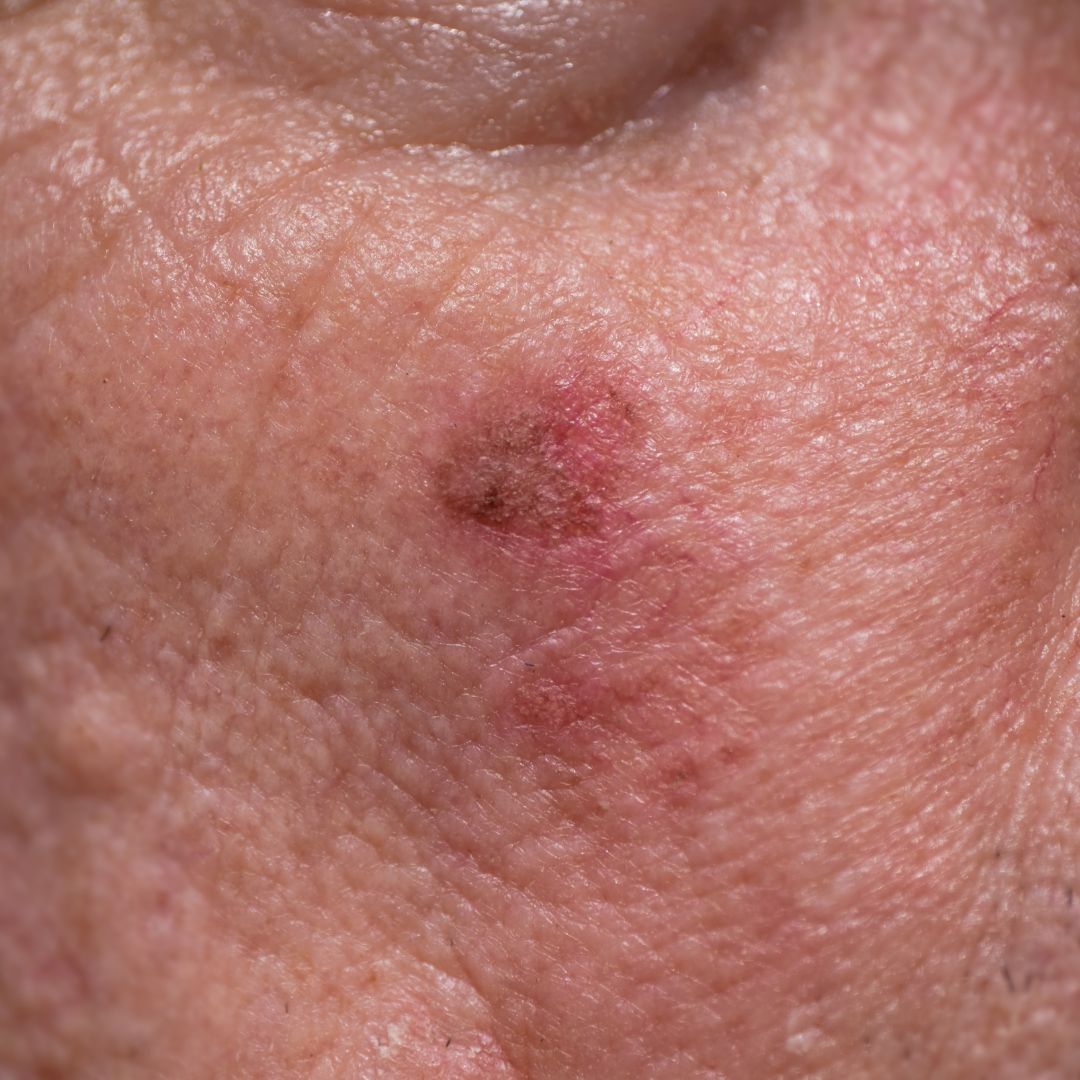
A close up of a cheek shows something we see constantly: a patch of skin that is rough, reddened, and slightly scaly, with a darker crusted center standing out against the surrounding redness. It is not dramatic looking. It is small, textured, and easy to dismiss as a bump or an irritation that will fade with time on its own.
That kind of patch is often actinic keratosis, the most common skin condition caused by sun damage. It develops after skin has been exposed to the sun repeatedly over many years, which means it tends to show up on the face, ears, scalp, forearms, and hands, the areas that spend the most time uncovered outdoors across a lifetime.
The mechanism is cumulative. Every sunburn and every ordinary afternoon outside adds a small amount of damage to skin cells. Actinic keratosis is what that accumulated damage looks like on the surface: a rough, dry, or scaly patch that may be pink, red, or brown, and that often feels more textured than it looks.
Most cases of actinic keratosis are harmless in the sense that they will not cause pain or spread on their own. But there is a small risk that a patch like this can eventually progress into skin cancer if it is left alone indefinitely. That risk is not large for any single patch, but it is real enough that we do not treat these spots as purely cosmetic.
This is why we usually recommend treatment rather than a wait and see approach. Treatment does not need to mean anything dramatic. It typically means addressing the patch directly so the damaged cells are cleared, rather than letting the area continue to sit there for years while the skin around it keeps accumulating additional sun exposure.
When someone comes in with a patch like this, we look at texture as much as color. A patch that feels rough or sandpapery under a fingertip is often more telling than how visible it is to the eye. We also consider how long it has been there and whether it has changed in size, shape, or thickness recently, since change is often the detail that matters.
Actinic keratosis rarely shows up as a single isolated patch. If years of sun exposure produced one spot, there is a reasonable chance nearby skin has some degree of similar damage, even if it has not become visible yet. That is part of why we look at the surrounding skin as carefully as the specific patch someone came in to ask about.
None of this requires alarm, but it does deserve attention. A rough patch that has been sitting on sun exposed skin for a while is worth having looked at properly rather than covered with makeup or ignored. Catching actinic keratosis early keeps treatment simple and keeps the small risk attached to it from ever becoming a bigger conversation.
Draft story for luciddermatology.com · Skin Health
A closer look at why Mohs surgery offers a higher cure rate than standard excision and what that means for patients.
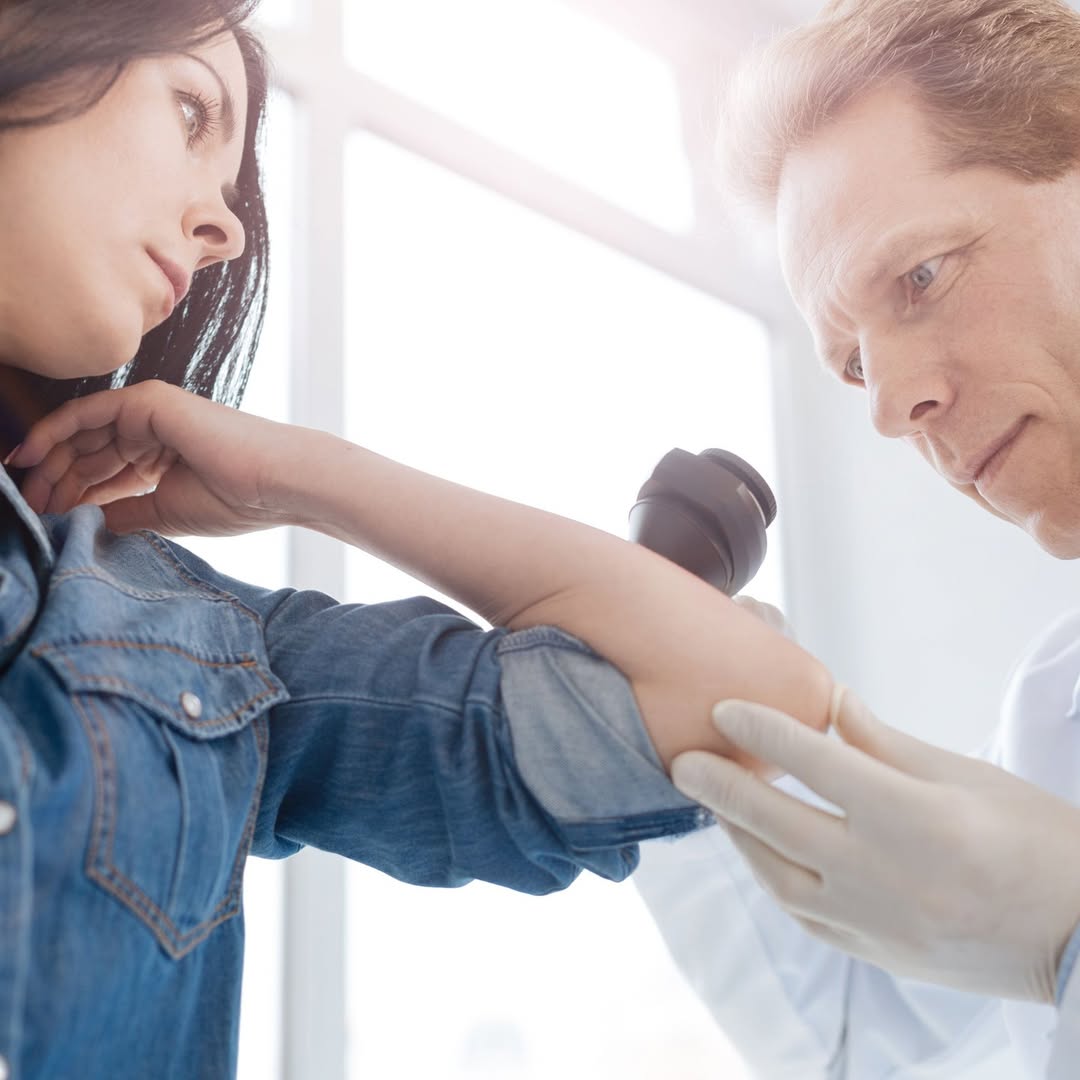
A gloved hand steadies a raised forearm under close light while a dermatologist leans in with a magnifying tool, checking a small patch of skin with total focus. It is a quiet moment, but it represents one of the more consequential decisions in dermatology: how a suspicious spot gets removed, and how confident everyone can be that all of it is actually gone.
That confidence is the whole case for Mohs surgery. Compared with a standard surgical excision, Mohs carries a cure rate of 98 percent, which is a meaningfully higher number for anyone facing a skin cancer diagnosis. The difference comes down to method, not effort. Both procedures aim to remove cancerous tissue completely, but they get there in very different ways.
A standard excision removes the visible lesion along with a margin of healthy looking skin, then sends that tissue to a lab for review, often a day or more later. If cancer cells remain at the edge, a second procedure may be needed. Mohs changes the order of operations entirely, checking the tissue before the patient ever leaves the chair.
During Mohs surgery, we remove the visible tissue in thin layers, one at a time. Each layer is mapped, frozen, and examined under a microscope on site, while the patient waits nearby. If the margins are clear, the procedure is finished. If cancer cells remain anywhere along the edge, we remove another targeted layer from that exact spot and check again.
This layer by layer approach is what pushes the cure rate above standard excision. Instead of estimating a safe margin and hoping the lab confirms it later, we are looking at 100 percent of the surgical margin in real time. Nothing is left to a follow up call or a second scheduled surgery. The tissue is either clear before we stop, or it is not.
That precision also protects healthy tissue, which matters most on the face, ears, hands, and other areas where every millimeter counts. Because Mohs only removes what needs to be removed, patients are often left with a smaller wound than a standard excision would require, since there is no need to take a wider margin just to be cautious about what the lab might find later.
None of this depends on guesswork or a single visual impression. It depends on a careful, physical process: raising the arm, steadying it, checking the tissue closely, and repeating that scrutiny as many times as the margins demand. It is slow by design, and that slowness is exactly why the outcome holds up.
For anyone weighing treatment options after a skin cancer diagnosis, the reliability difference is the detail worth sitting with. A 98 percent cure rate is not a marginal edge, it is the reason Mohs has become the approach of choice for cancers in visible, sensitive, or high risk areas, where getting it right the first time matters as much as getting it done at all.
Keep reading