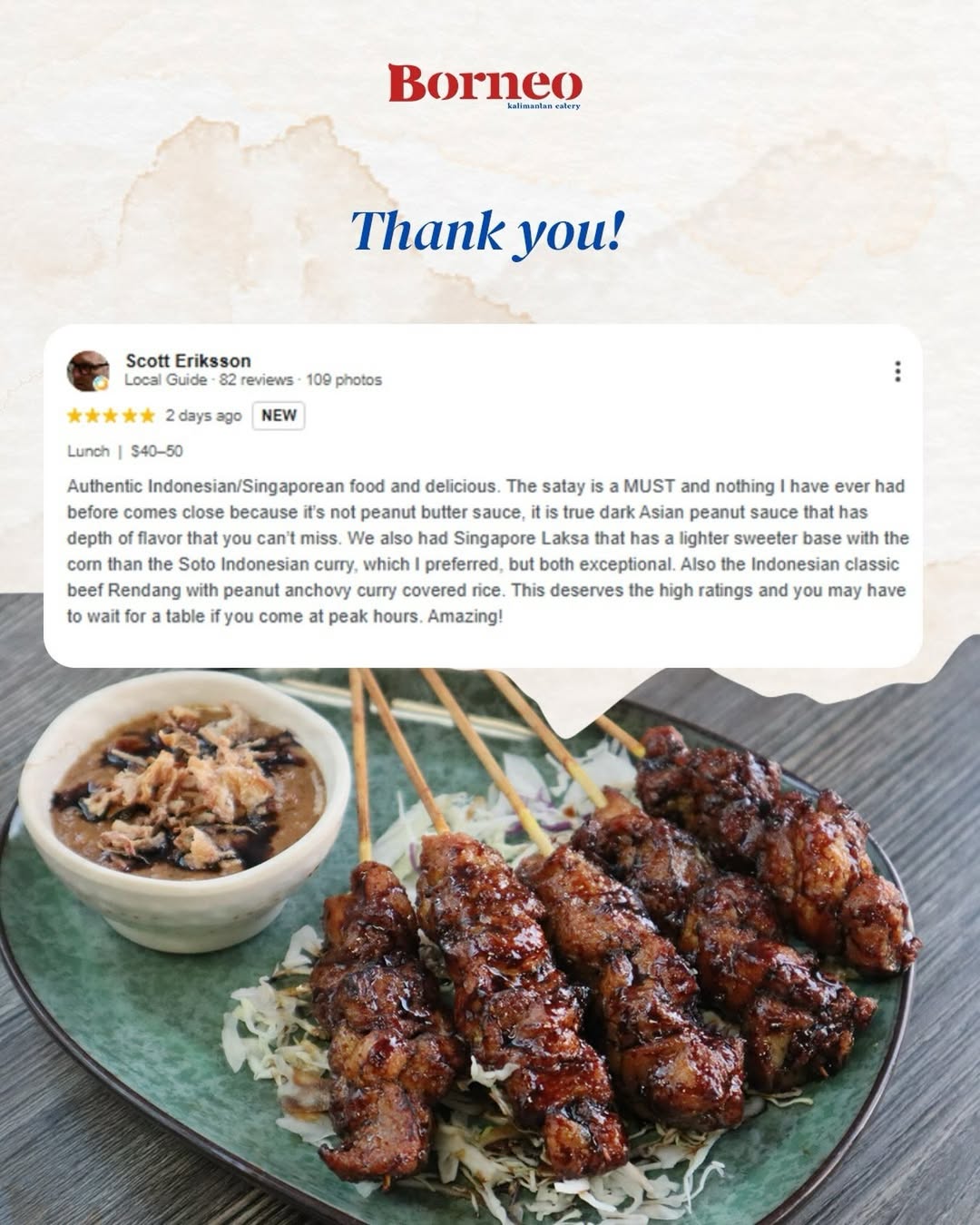
Why one reviewer says the satay at Borneo Kalimantan Cuisine is a must order
A five star review calls out the satay and its dark peanut sauce, and we are happy to let the dish speak for itself.
BORNEO KALIMANTAN CUISINE STAFFTurn your social into search
We turn your posts into editorial stories that bring new search traffic to borneoeatery.com. Three of yours will be on this page.
Book a demo
borneoeatery_la When the review says the Satay is a MUST, we’ll take it. 🙌🔥 Thank you for the love! Nothing makes us happier than seeing our guests discover and enjoy the Southeast Asian flavors we grew up with. #michelinguide #toplarestaurants #asianfood
A five star review calls out the satay and its dark peanut sauce, and we are happy to let the dish speak for itself.
BORNEO KALIMANTAN CUISINE STAFFHow it works
Same as today. Nothing changes on Instagram.
We turn your post into a full story in your voice within the hour.
One click publishes it to borneoeatery.com. Nothing goes live without you.
Your stories
Nothing was published anywhere. You decide that. Every word will come from your own posts, your own photos and your own menu.
Guest Review · From your post
A five star review calls out the satay and its dark peanut sauce, and we are happy to let the dish speak for itself.
“When the review says the Satay is a MUST, we’ll take it. 🙌🔥 Thank you for the love! Nothing makes us happier than seeing our guests discover and enjoy the Southeast Asian flavors we grew up with. #michelinguide #toplarestaurants #asianfood”
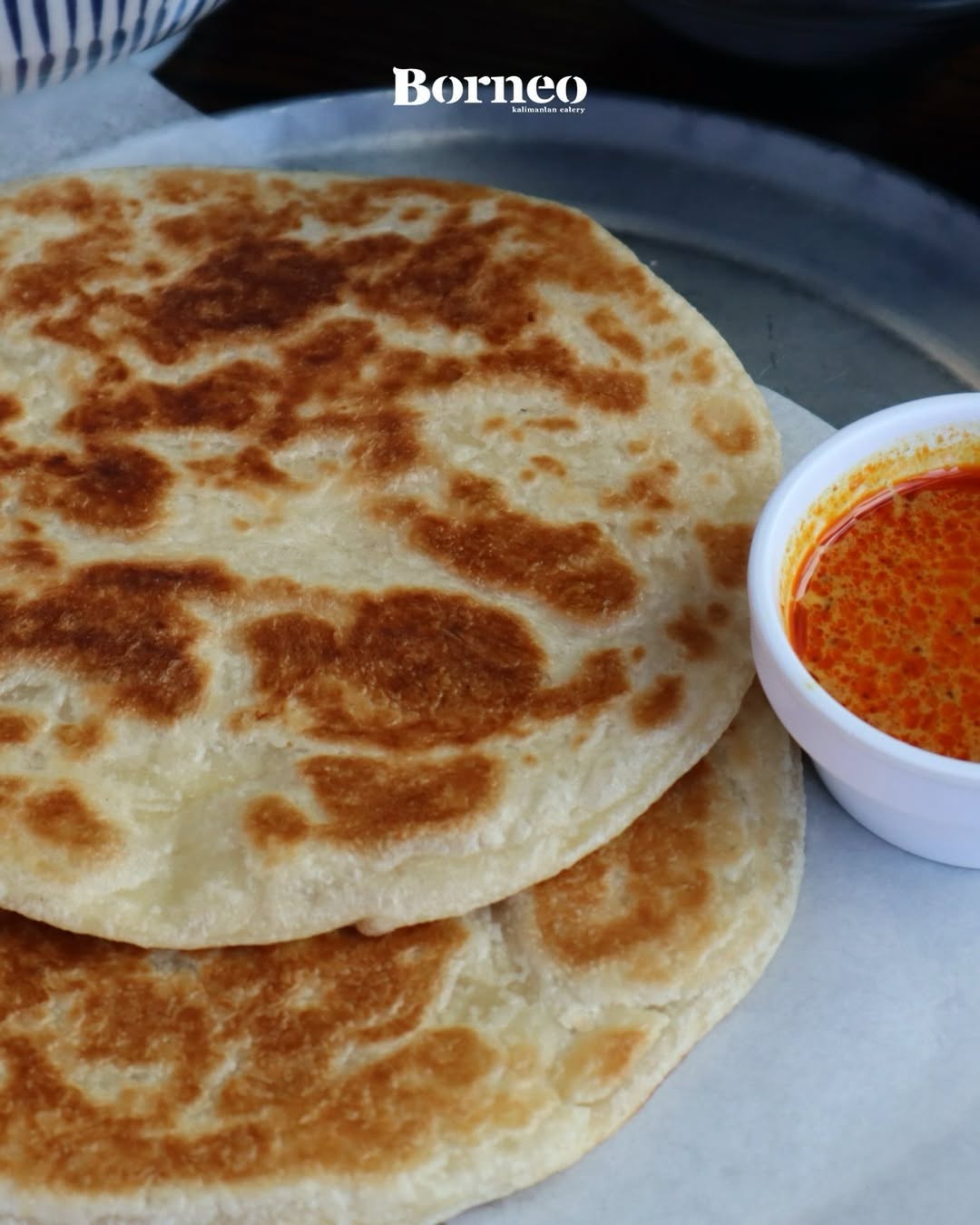
On The Table · From your post
Two flaky rounds and a small cup of curry make the case for a bread most people have never tried.
“Crispy. Flaky. Buttery. And even better dipped in curry. 🤤 If you’ve never tried Roti Prata before, consider this your sign. Tear, dip, repeat, you’ll get it after the first bite. #michelinguide #toplarestaurants #asianfood”
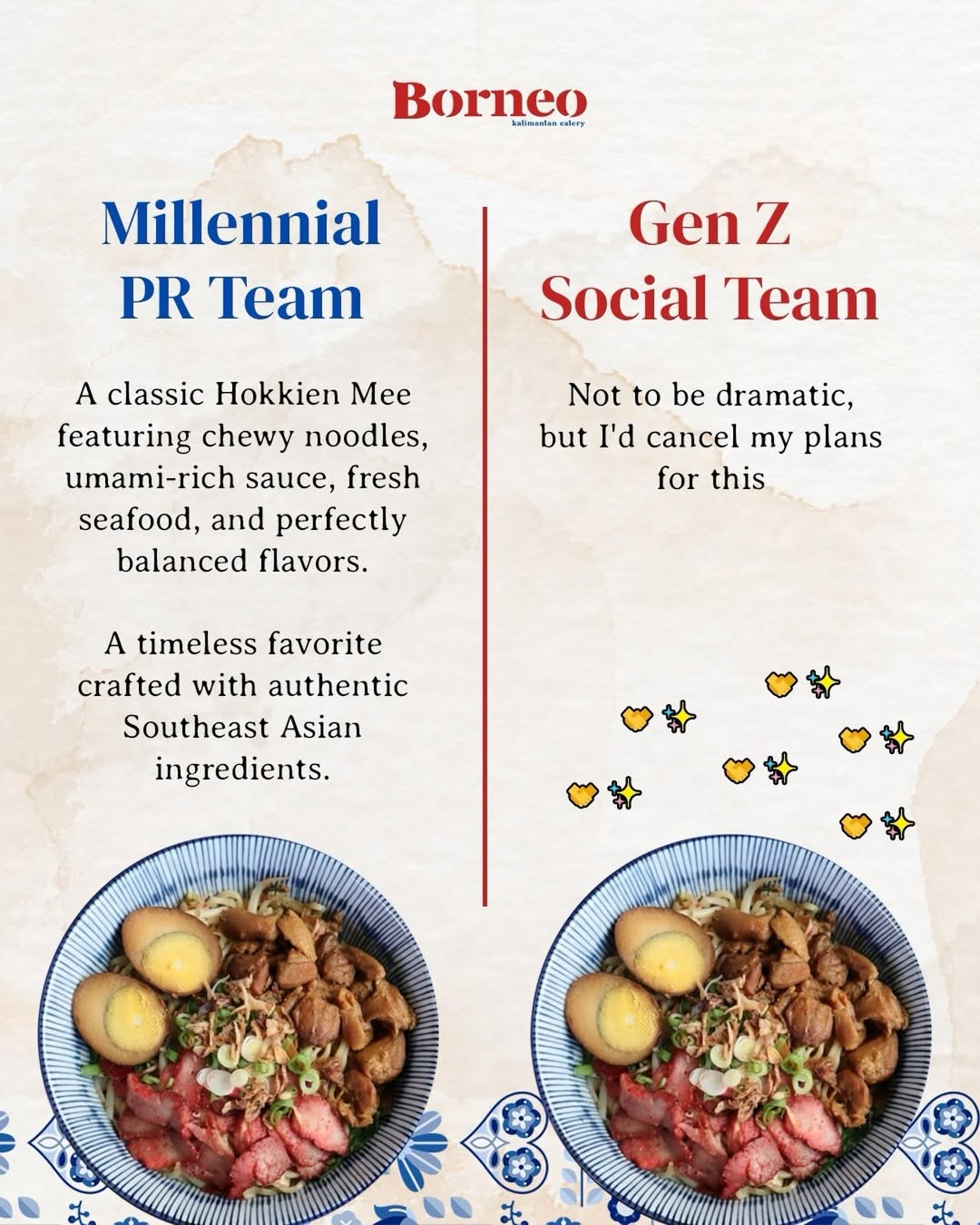
House Specialty · From your post
One dish, two generations of explanation, and a bowl of noodles that backs up both versions.
“Millennial explanation vs. Gen Z reaction. 😆 But both agree on one thing. this Hokkien Mee is seriously good. Savory, satisfying, and packed with flavor, one bite and you’ll understand the hype. 🍜✨ #michelinguide #toplarestaurants #asianfood”
One social post becomes another searchable entry point to Borneo Kalimantan Cuisine.
Our own magazine. Clicks and citations from Google Search Console, as of September 15, 2026.
Draft story for borneoeatery.com · Guest Review
A five star review calls out the satay and its dark peanut sauce, and we are happy to let the dish speak for itself.
A recent five star review named one dish before any other: the satay. The reviewer called it a must, and specifically pointed to the sauce, describing it as a true dark Asian peanut sauce rather than anything resembling peanut butter. That distinction matters to us, because the sauce is where a lot of the dish's character actually lives.
The plate itself tells part of that story. Skewers of glazed, charred meat arrive fanned out over a bed of shredded cabbage, each one dark at the edges where the marinade has caramelized against open flame. Beside them sits a small bowl of thick, deep brown sauce topped with crisp fried shallots, the kind of finishing touch that adds texture as much as flavor.
The reviewer was specific about why the sauce stood out, noting its depth of flavor compared to a more familiar, sweeter peanut butter style sauce. That kind of detail is easy to miss unless you are paying attention while eating. It is also exactly the kind of flavor we grew up with, built around real depth rather than sweetness alone, and it is part of why the dish keeps getting singled out.
Satay is a simple format on paper: meat, skewer, sauce. But the review makes clear that simple does not mean interchangeable. The same reviewer tried the Singapore laksa and the soto Indonesian curry in the same visit, noting real differences between the two, from a lighter, sweeter corn based broth to something more traditionally savory. Even with that range on the table, the satay was the dish called out first.
That same visit also included the Indonesian classic beef rendang, served with peanut anchovy curry over rice, a dish built on a completely different flavor base than the satay's char and peanut sauce. Reading through everything ordered in one lunch, from curry to rendang to skewers, gives a sense of how much range sits across a single table when a few dishes are ordered together.
The review also mentioned something practical worth repeating: tables can fill up during peak hours. That is not a claim we are making about ourselves, it is simply what one guest experienced firsthand during lunch. If satay is the plan, and based on this review it might be, arriving outside the busiest window is a reasonable way to make sure there is a seat waiting.
When we grow up eating Southeast Asian food shaped by family and region, sharing it with new guests always carries a little bit of risk. Will the sauce read as unfamiliar. Will the char be too much or too little. Reviews like this one tell us when that risk pays off, especially when someone takes the time to explain exactly what set a dish apart for them.
Seeing a review specifically praise the satay sauce for its depth, rather than just calling the meal good, tells us the flavors we associate with home are landing the way we hoped. It is not about the star rating alone, it is about a guest noticing the difference between a familiar peanut sauce and the real one, and choosing to write it down in detail.
Draft story for borneoeatery.com · On The Table
Two flaky rounds and a small cup of curry make the case for a bread most people have never tried.
Two rounds sit stacked on a metal tray, blistered gold in some spots and pale in others, the layers visible where the dough was folded over itself before it hit the pan. Next to them is a small white cup of curry, thin enough to soak into torn pieces rather than sit on top of them. Nothing else is on the plate. It does not need anything else.
Roti prata is not a dish that hides what it is. The surface tells you what happened to it: high heat, real butter, and a dough that was pulled and folded until it could go crisp on the outside while staying soft enough underneath to tear cleanly. The color does the explaining. Darker patches mean more contact with the pan, and that contact is where the flavor comes from.
We describe it as crispy, flaky, and buttery because that is genuinely the order you notice it in. The crispness hits first, right at the edge where the layers separate. Then the flake, which is really just steam trying to escape through dough that has been folded over on itself several times. Buttery comes last, once you are already chewing, which is usually when people decide they want another piece.
The curry in that small cup is not a garnish. It is there because roti prata is built to be dipped, not eaten plain. The bread is intentionally a little bland on its own, which is not a flaw, it is the design. Plain dough gives the curry somewhere to land, and the curry gives the bread a reason to keep going past the first bite.
Our advice for anyone trying it for the first time is simple: tear, dip, repeat. Do not overthink the piece size or worry about technique. Roti prata is meant to be pulled apart by hand, not cut with a fork and knife. The tearing is part of how the texture reveals itself, since each torn edge exposes a slightly different mix of crisp and soft.
People who have never had roti prata tend to expect something closer to naan or paratha, and it is related to both, but the folding technique and the butter change the outcome. It is thinner in places, thicker in others, and the unevenness is the point rather than something to fix. That is also why no two pieces look exactly alike once they come off the pan.
If this is your first time seeing it, treat it the way we would tell a friend to: order it, dip it immediately, and do not wait for it to cool. Roti prata loses some of its crispness the longer it sits, so the ideal window is short. That is also part of why it works so well as a starter, since it disappears fast and sets the tone for everything that follows.
Most people who try roti prata once end up ordering it again without needing to be convinced a second time. It is a simple combination, bread and curry, but the contrast between the two is what makes it memorable. Tear, dip, repeat is not just advice. It is basically the whole meal in three words.
Draft story for borneoeatery.com · House Specialty
One dish, two generations of explanation, and a bowl of noodles that backs up both versions.
There are two ways to talk about our Hokkien Mee, and we like both of them. One reads like a menu description. The other reads like a text message sent in a hurry. Put side by side, they make the same point from opposite directions, which is exactly why we find the comparison funny and also, honestly, pretty accurate.
The formal version goes something like this: chewy noodles, an umami rich sauce, fresh seafood, and balanced flavors built from Southeast Asian ingredients. That is the explanation you would expect from anyone trying to describe the dish properly, in full sentences, without shorthand. It is accurate. It is also, we will admit, a little stiff for a bowl of noodles this good.
The other version skips the description entirely and jumps straight to the reaction: not to be dramatic, but this is worth canceling plans for. No breakdown of technique, no list of ingredients, just an immediate and slightly exaggerated response to a bowl of noodles. It is less informative and somehow more honest, because it captures what actually happens the moment the dish lands on the table.
Look past the framing and the bowl itself tells its own story. Char siu slices sit against the noodles with visible caramelized edges, alongside soft boiled egg halves with just set yolks, cucumber for crunch, and a scatter of scallion and crispy shallot on top. Everything is arranged in the same wide, blue and white patterned bowl, the kind built for a dish meant to be eaten fully mixed, not picked apart.
Hokkien Mee is a noodle dish that lives or dies on how well the sauce clings to the noodles, and that is where the seriousness of the description actually earns its place. Savory and seafood forward, it is built to coat rather than pool, so every noodle carries flavor instead of sitting in a puddle of it. That balance is the difference between a good bowl and a forgettable one.
What makes the comparison work is that neither side is wrong. The measured explanation and the impulsive reaction are describing the same plate from two different instincts, one trying to be precise, the other trying to be honest in the moment. We did not have to choose a side when we made the dish, and we do not think anyone eating it has to choose one either.
At the counter, most people are not thinking in full sentences anyway. They are thinking about whether the char siu has a good edge, whether the egg yolk is still soft, whether the noodles taste like something worth coming back for. Those are Gen Z reaction questions, not millennial PR questions, and they get answered fast, usually somewhere around the third bite.
So take your pick. Call it a classic Hokkien Mee crafted with authentic Southeast Asian ingredients, or just say you would cancel plans for it. We will keep serving the same bowl either way, chewy noodles, char siu, soft egg, and a sauce built to be tasted all the way to the bottom, no explanation required to enjoy it.
Keep reading