
Losing hair on a GLP1? The cause is rarely the medication alone
Rapid weight loss and shifting nutrient intake can put hair growth under stress, but the root cause is usually fixable.
BIOCURE HEALTH STAFFTurn your social into search
We turn your posts into editorial stories that bring new search traffic to getbiocure.com. Three of yours will be on this page.
Book a demo
getbiocure 💇♀️ Losing hair while taking a GLP 1? You’re not alone, but it’s not the medication alone that’s usually to blame. Rapid weight loss can place your body under stress, increasing the risk of temporary hair shedding. At the same time, eating less can make it harder to get enough protein, vitamins, and essential minerals needed to support healthy hair growth. Common deficiencies that may contribute to hair loss include. ✔️ Protein ✔️ Iron ✔️ Zinc ✔️ Vitamin D ✔️ Biotin ✔️ B Vitamins ✔️ Essential fatty acids The good news? In many cases, this can be addressed with the right strategy. At BioCure Health, we don’t just focus on helping you lose weight, we focus on helping you stay healthy while doing it. That’s why we often recommend micronutrient testing during GLP 1 therapy to identify nutritional deficiencies before they become bigger problems. With the right plan, we can support healthy hair growth by combining. ✨ Personalized vitamin and mineral supplementation ✨ Adequate protein intake ✨ Physician guided peptide therapy when appropriate (topical and/or injectable) ✨ A comprehensive evaluation to identify and correct the root cause of hair loss Healthy weight loss shouldn’t come at the expense of your hair, your energy, or your long term health. Your body functions best when it has the nutrients it needs. Optimizing your vitamin and mineral status supports not only healthy hair, but also your metabolism, immune system, muscle preservation, brain function, and overall well being. 📩 DM BioCure Health or Call/Text (754) 206 0838 to schedule a consultation and learn how to optimize your GLP 1 journey while protecting your hair and overall health. Every treatment plan is personalized. Your physician will determine which testing and therapies are appropriate for your individual needs. #BioCureHealth #GLP1 #HairLoss #HealthyWeightLoss #LongevityMedicine
Rapid weight loss and shifting nutrient intake can put hair growth under stress, but the root cause is usually fixable.
BIOCURE HEALTH STAFFHow it works
Same as today. Nothing changes on Instagram.
We turn your post into a full story in your voice within the hour.
One click publishes it to getbiocure.com. Nothing goes live without you.
Your stories
Nothing was published anywhere. You decide that. Every word will come from your own posts, your own photos and your own treatments.
GLP1 and hair · From your post
Rapid weight loss and shifting nutrient intake can put hair growth under stress, but the root cause is usually fixable.
“💇♀️ Losing hair while taking a GLP 1? You’re not alone, but it’s not the medication alone that’s usually to blame. Rapid weight loss can place your body under stress, increasing the risk of temporary hair shedding. At the same time, eating less can make it harder to get enough protein, vitamins, and essential minerals needed to support healthy hair growth. Common deficiencies that may contribute to hair loss include. ✔️ Protein ✔️ Iron ✔️ Zinc ✔️ Vitamin D ✔️ Biotin ✔️ B Vitamins ✔️ Essential fatty acids The good news? In many cases, this can be addressed with the right strategy. At BioCure Health, we don’t just focus on helping you lose weight, we focus on helping you stay healthy while doing it. That’s why we often recommend micronutrient testing during GLP 1 therapy to identify nutritional deficiencies before they become bigger problems. With the right plan, we can support healthy hair growth by combining. ✨ Personalized vitamin and mineral supplementation ✨ Adequate protein intake ✨ Physician guided peptide therapy when appropriate (topical and/or injectable) ✨ A comprehensive evaluation to identify and correct the root cause of hair loss Healthy weight loss shouldn’t come at the expense of your hair, your energy, or your long term health. Your body functions best when it has the nutrients it needs. Optimizing your vitamin and mineral status supports not only healthy hair, but also your metabolism, immune system, muscle preservation, brain function, and overall well being. 📩 DM BioCure Health or Call/Text (754) 206 0838 to schedule a consultation and learn how to optimize your GLP 1 journey while protecting your hair and overall health. Every treatment plan is personalized. Your physician will determine which testing and therapies are appropriate for your individual needs. #BioCureHealth #GLP1 #HairLoss #HealthyWeightLoss #LongevityMedicine”

Preventive Health · From your post
We have partnered with a laboratory to make broader blood panel testing accessible, with at home draws available in Fort Lauderdale.
“🧪 Great news from BioCure Health! We’ve partnered with a laboratory to make comprehensive functional blood work more accessible, now available for only $100. Instead of relying on a basic panel that may only test what insurance considers medically necessary, functional lab work takes a broader look at the markers that can help us better understand your metabolism, hormones, nutrient status, inflammation, and overall health. Don’t wait for something to go wrong before you start looking deeper. Preventive testing gives you the opportunity to understand what’s happening in your body now and make more informed decisions about your health. ✨ Complete functional & comprehensive blood work analysis 🏡 At home blood draw convenience available 📊 Deeper insights for a more personalized health plan Call or text (754) 206 0838 to schedule your lab work today. Phlebotomist services and physician interpretation are charged separately. #BioCureHealth #FunctionalMedicine #FunctionalLabs #BloodWork #PreventiveHealth LongevityMedicine HealthOptimization PersonalizedMedicine Wellness HealthyAging KnowYourNumbers”
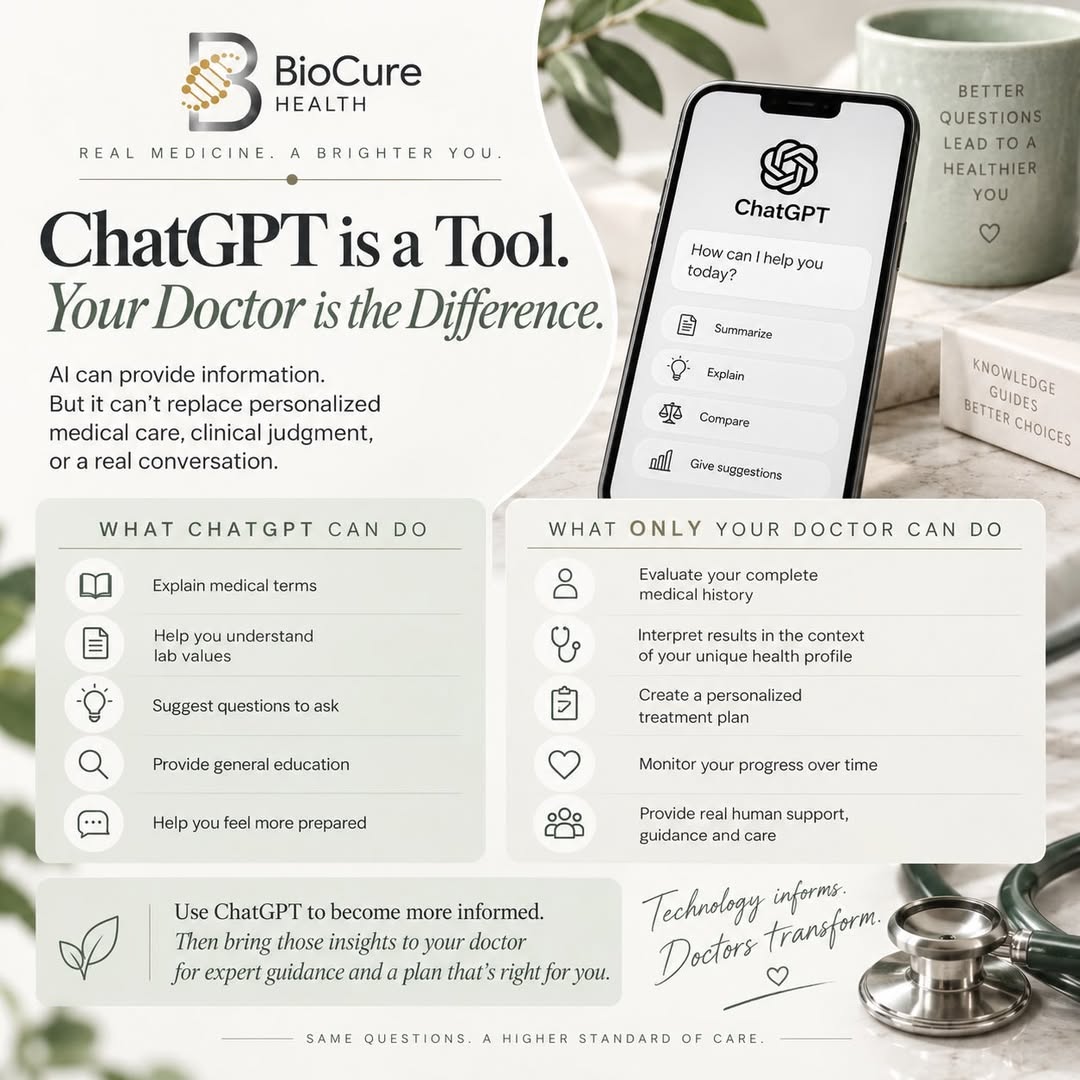
Patient Education · From your post
AI can help you prepare better questions about your health, but it takes a physician to turn those questions into a real plan.
“ChatGPT can be a powerful tool, but it should never replace a real conversation with your doctor. AI can help you organize information, understand terminology, and prepare better questions about your health. But it doesn’t know your full medical history, examine you, monitor changes over time, or understand the complete context behind your symptoms and lab results. At BioCure Health, we believe technology is most valuable when it supports, not replaces personalized medical care. Your physician brings something AI cannot. clinical judgment, experience, individualized guidance, and a real human conversation centered around you. Use ChatGPT to become more informed. Then bring those questions and insights to a qualified healthcare professional who can help you make decisions safely and personally. Technology can provide information. Personalized care provides perspective. #BioCureHealth #PersonalizedMedicine #FunctionalMedicine #LongevityMedicine #HealthEducation ChatGPTHealth PatientEducation PreventiveHealth HealthOptimization DoctorPatientRelationship”
One social post becomes another searchable entry point to BioCure Health.
Our own magazine. Clicks and citations from Google Search Console, as of September 15, 2026.
Draft story for getbiocure.com · GLP1 and hair
Rapid weight loss and shifting nutrient intake can put hair growth under stress, but the root cause is usually fixable.
If your hair is coming out in the brush more than it used to since starting a GLP1, you are not imagining it and you are not alone. It is also not usually the medication itself doing the damage. In most cases, what is actually happening is a combination of rapid weight loss and a body that is quietly running low on the raw materials it needs to keep growing hair the way it normally would.
Losing weight quickly puts a real physiological load on the body, and that stress alone can trigger a temporary shedding phase. At the same time, eating less overall makes it harder to take in enough protein, vitamins, and minerals to support hair growth. Lower caloric intake and increased body stress are two sides of the same problem, and together they show up as thinning that feels sudden even though it built gradually.
The deficiencies we see most often connect directly to hair health: protein, iron, zinc, vitamin D, biotin, B vitamins, and essential fatty acids. None of these are exotic. They are common nutrients that become harder to maintain once caloric intake drops, and each one plays a specific role in keeping the hair growth cycle functioning normally instead of shifting into a resting or shedding phase.
The good news is that this is usually addressable once you know exactly what is missing. That is why we do not just focus on the number on the scale. We focus on helping you stay healthy while you lose weight, which means looking at what your body is short on before a temporary issue turns into something that takes much longer to reverse.
We often recommend micronutrient testing during GLP1 therapy specifically to catch nutritional deficiencies early, while they are still easy to correct. Testing gives us real data instead of guesswork, so the plan we build is based on what your body actually needs rather than a generic list of supplements that may not address what is really going on for you specifically.
From there, treatment can combine personalized vitamin and mineral supplementation, support for adequate protein intake, and physician guided peptide therapy when appropriate, whether topical or injectable. A comprehensive evaluation ties it together, identifying and correcting the root cause rather than just treating the visible symptom. Every plan is personalized, and your physician determines which testing and therapies fit your specific needs.
Healthy weight loss should not come at the expense of your hair, your energy, or your long term health. Your body simply functions better when it has the nutrients it requires, and optimizing your vitamin and mineral status supports far more than hair growth. It also plays into your metabolism, immune system, muscle preservation, brain function, and overall well being while you are losing weight.
If you are noticing more hair in the shower drain or on your pillow since starting a GLP1, it is worth understanding why before assuming it is simply part of the process. Call or text 754 206 0838 to schedule a consultation and learn how to optimize your treatment plan while protecting both your hair and your overall health.
Draft story for getbiocure.com · Preventive Health
We have partnered with a laboratory to make broader blood panel testing accessible, with at home draws available in Fort Lauderdale.
Most people only get bloodwork done when something already feels wrong, and even then, insurance often decides what actually gets tested. We wanted to change that starting point. Through a new partnership with a laboratory, we are now offering complete functional and comprehensive blood work analysis for $100, giving people in Fort Lauderdale a more accessible way to see what is actually happening inside their bodies before a problem forces the issue.
The difference comes down to what gets measured. A basic panel run through insurance is built around medical necessity, which means it often stops short of the fuller picture. Functional lab work is designed to go broader, looking at markers connected to metabolism, hormones, nutrient status, and inflammation, so the results reflect overall health rather than just ruling out an immediate concern.
Insurance testing exists to catch problems that are already defined and already measurable by a narrow standard. It is not designed to map out the slower, quieter shifts happening in someone's metabolism or hormone levels long before those changes become a diagnosis. That gap is exactly where preventive testing becomes useful, because it gives people a chance to notice patterns early instead of waiting for a symptom to force the conversation.
A comprehensive functional panel takes a wider approach on purpose. Instead of checking a short list of values, it looks across systems that influence each other, including metabolic function, hormonal balance, nutrient levels, and inflammation markers. Together, these give a more complete read on where someone's health actually stands, which makes it easier to build a plan around real information instead of guesswork.
For people who would rather not carve out time for a lab visit, we offer at home blood draw convenience as part of this service. A phlebotomist comes to you, which removes one of the more common reasons people put off bloodwork in the first place. It keeps the process private and manageable, fitting into someone's actual schedule instead of asking them to rearrange their day around a waiting room.
Phlebotomist services and physician interpretation are billed separately from the $100 testing fee, so it is worth knowing that upfront when scheduling. The interpretation step matters just as much as the draw itself, since a page of lab values only becomes useful once someone explains what those numbers mean for a person's specific health picture and where attention might be needed.
The value of this kind of testing is not the panel itself, it is what someone does with the results. Understanding where hormone levels, nutrient status, or inflammation markers currently sit gives a person the ability to make informed decisions rather than reactive ones. That shift, from waiting to see what happens to actually knowing where things stand, is the core idea behind offering this at a more accessible price.
Booking is simple. Call or text seven five four, two zero six, zero eight three eight to schedule lab work, whether that means coming in or arranging an at home draw. For anyone who has been meaning to get a fuller picture of their health but held off because of cost or convenience, this is the moment those two obstacles are no longer standing in the way.
Draft story for getbiocure.com · Patient Education
AI can help you prepare better questions about your health, but it takes a physician to turn those questions into a real plan.
Search your symptoms, ask a chatbot to explain a lab value, or type in a question you were too rushed to ask at your last appointment. It happens constantly now, and there is nothing wrong with it. AI can be a genuinely useful starting point for understanding your own health. The problem shows up when that starting point gets mistaken for an ending point.
ChatGPT is good at specific things. It can explain medical terms in plain language, help you understand what a lab value actually means, suggest questions worth asking at your next visit, and offer general education on a topic you are trying to learn more about. Used this way, it can help you walk into an appointment more prepared and more confident about what you want to discuss.
What it cannot do is know you. It has no access to your full medical history, cannot examine you, cannot monitor how your body changes over time, and cannot understand the full context behind your symptoms or your results. It can describe a condition in general terms. It cannot tell you what that condition means for your specific body, your history, or your life.
That gap is exactly where a physician's judgment matters. Interpreting a lab result in the context of your unique health profile, evaluating your complete medical history, and building a treatment plan that is actually personalized to you all require a level of understanding that comes from real evaluation, not from a general knowledge base. Clinical judgment is built on experience with real patients, not on pattern matching alone.
We think about this as two different jobs. Technology is well suited to informing you. A doctor is suited to transforming that information into something usable: a plan, a diagnosis, a next step that accounts for everything happening in your life and your body at once. One replaces neither the other nor the human support, guidance, and ongoing care that come with an actual relationship with your provider.
So we are not telling patients to avoid AI. We are telling them how to use it well. Ask ChatGPT to explain what a term means. Ask it to help you understand a result. Ask it to help you think through what questions you should be asking. Then bring all of that, the questions and the insights, into the room with a qualified healthcare professional.
That conversation is where the real work happens. A physician can take the questions you arrived with and evaluate them against your actual history, monitor how things shift over time, and build guidance that fits your circumstances rather than a general case. That is the difference between information and perspective, and it is not one a search bar or a chat window can offer on its own.
Come in informed. That is genuinely useful, and we would rather you arrive with questions than without them. Just remember what informed is for: it is the beginning of a conversation with your doctor, not a substitute for one. The technology can organize your thinking. The plan that comes out of it still needs a real person behind it.
Keep reading