
When a slow healing leg wound points back to your veins
A sore that will not close is often a circulation problem wearing the disguise of a skin problem.
ASTRA VEIN TREATMENT CENTER STAFFTurn your social into search
We turn your posts into editorial stories that bring new search traffic to astraveinvascular.com. Three of yours will be on this page.
Book a demo
astraveinvascular What Exactly Is a Venous Stasis Wound? A venous stasis wound, also called a venous leg ulcer, can develop when blood has difficulty flowing back up from the legs to the heart. This can cause blood and fluid to build up, increasing pressure in the veins and making the skin more vulnerable to breakdown. Common signs include. • A sore that heals slowly or keeps returning • Swelling around the ankle or lower leg • Darkening or discoloration of the skin • Itching, dryness, or thickened skin • Aching or heaviness in the legs Because the underlying problem involves circulation, treating only the wound may not address the cause. A proper vein evaluation can help identify whether venous insufficiency is contributing to the problem. At Astra Vein Treatment Center, Dr. George Bolotin evaluates vein health and can recommend appropriate treatment based on the underlying condition. Schedule a vein evaluation if you have a wound that isn’t healing as expected. #VenousStasisWound #VenousLegUlcer #VenousInsufficiency
A sore that will not close is often a circulation problem wearing the disguise of a skin problem.
ASTRA VEIN TREATMENT CENTER STAFFHow it works
Same as today. Nothing changes on Instagram.
We turn your post into a full story in your voice within the hour.
One click publishes it to astraveinvascular.com. Nothing goes live without you.
Your stories
Nothing was published anywhere. You decide that. Every word will come from your own posts, your own photos and your own treatments.
Vein Health · From your post
A sore that will not close is often a circulation problem wearing the disguise of a skin problem.
“What Exactly Is a Venous Stasis Wound? A venous stasis wound, also called a venous leg ulcer, can develop when blood has difficulty flowing back up from the legs to the heart. This can cause blood and fluid to build up, increasing pressure in the veins and making the skin more vulnerable to breakdown. Common signs include. • A sore that heals slowly or keeps returning • Swelling around the ankle or lower leg • Darkening or discoloration of the skin • Itching, dryness, or thickened skin • Aching or heaviness in the legs Because the underlying problem involves circulation, treating only the wound may not address the cause. A proper vein evaluation can help identify whether venous insufficiency is contributing to the problem. At Astra Vein Treatment Center, Dr. George Bolotin evaluates vein health and can recommend appropriate treatment based on the underlying condition. Schedule a vein evaluation if you have a wound that isn’t healing as expected. #VenousStasisWound #VenousLegUlcer #VenousInsufficiency”

Vein Health · From your post
Recurring leg heaviness, swelling, or aching can point to how well blood is actually moving through your legs.
“Do Your Legs Feel Heavy by the End of the Day? You sit at work for hours. You stand all day. You finally get home. and your legs feel tired, achy, swollen, or unusually heavy. Sometimes, it’s simply been a long day. But when these symptoms happen frequently, they may be connected to how well blood is moving through your legs. Pay attention to signs like. • Swollen ankles or feet • Cold feet or tingling • Leg cramps when walking • Aching or heaviness that keeps returning • Skin color or texture changes • Sores that take longer to heal Poor circulation can have different causes, including venous insufficiency, varicose veins, peripheral artery disease, diabetes, and other health conditions. Instead of simply getting used to uncomfortable legs, consider having persistent symptoms evaluated. Astra Vein Treatment Center provides personalized vein and circulation evaluations with Dr. George Bolotin. Schedule an evaluation to better understand what may be causing your symptoms. #PoorCirculation #LegHealth #VeinHealth #HeavyLegs #SwollenLegs”
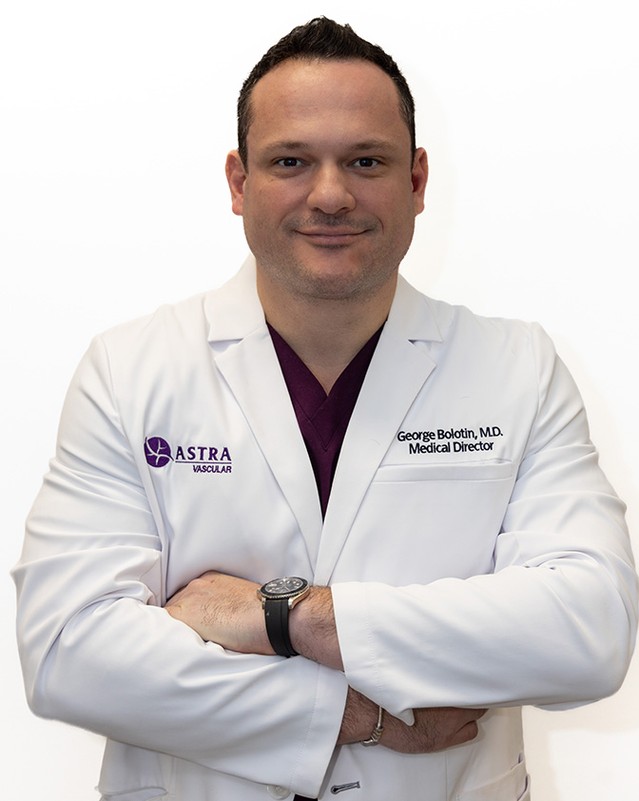
Medical Director · From your post
Dr. George Bolotin's background in vascular and fibroid treatment shapes how care is delivered at Astra Vein Treatment Center.
“14+ Years of Experience in Vein & Fibroid Care When it comes to vein and vascular care, experience matters. Dr. George Bolotin brings more than 14 years of experience in advanced surgical and minimally invasive treatments for varicose veins, circulation concerns, and other vascular conditions. He is also highly experienced in fibroid diagnosis and treatment, including minimally invasive approaches. Earned his MD from Saint George’s University in 2012. Completed advanced specialty training with leading experts. Focuses on personalized, image guided care At Astra Vein Treatment Center, Dr. Bolotin combines specialized training with a patient focused approach to help you understand your condition and treatment options. Schedule a consultation today. #DrGeorgeBolotin #AstraVeinTreatmentCenter #VascularCare #VaricoseVeins”
One social post becomes another searchable entry point to Astra Vein Treatment Center.
Our own magazine. Clicks and citations from Google Search Console, as of September 15, 2026.
Draft story for astraveinvascular.com · Vein Health
A sore that will not close is often a circulation problem wearing the disguise of a skin problem.
A wound on the lower leg that refuses to close is easy to treat as a skin problem. Clean it, cover it, wait. But when a sore lingers for weeks or keeps reopening after it seems to heal, the skin itself is usually not the source of the trouble. The real issue often sits deeper, in how well blood is moving back up the leg toward the heart.
That kind of sore has a name: a venous stasis wound, sometimes called a venous leg ulcer. It develops when blood has difficulty returning from the legs, allowing blood and fluid to pool and pressure to build inside the veins. Over time that pressure makes the skin more fragile and less able to repair itself, which is why an ordinary scrape or irritation in that area can turn into something that will not fully heal.
The wound itself is often the last sign to appear, not the first. Swelling around the ankle or lower leg, aching or heaviness after a long day, and skin that starts to darken, thicken, or feel unusually dry or itchy can all show up beforehand. These are the legs quietly signaling that circulation is under strain long before a sore ever forms.
None of these signs are dramatic on their own, which is exactly why they get dismissed. Heaviness gets blamed on standing too long. Discoloration gets blamed on age or sun. But when several of these show up together, especially alongside a wound that heals slowly or returns, they point toward the same underlying mechanism: blood struggling to flow the way it should.
A wound care routine can manage the surface of the problem, cleaning it, dressing it, watching it. What it cannot do is correct the pressure building underneath, which means the same wound can return even after it appears to close. Addressing only the visible injury without asking why it formed in the first place tends to produce a cycle rather than a resolution.
That is where a proper vein evaluation becomes useful rather than optional. It helps determine whether venous insufficiency, meaning veins that are not efficiently returning blood upward, is the actual driver behind the skin breakdown. Once that mechanism is identified, the wound stops being treated as an isolated event and starts being treated as a symptom with a specific, addressable cause.
At Astra Vein Treatment Center, Dr. George Bolotin evaluates vein health directly, looking at how blood is flowing rather than only at how the skin looks. From there, appropriate treatment can be recommended based on what the underlying condition actually is, rather than applying a generic approach to a wound whose cause has not yet been identified.
If a leg wound is taking longer to heal than expected, or keeps coming back after it seems resolved, that pattern is worth a closer look rather than another round of waiting. Scheduling a vein evaluation is a reasonable next step for anyone noticing this pattern, particularly when it shows up alongside swelling, heaviness, or changes in the skin around the ankle or lower leg.
Draft story for astraveinvascular.com · Vein Health
Recurring leg heaviness, swelling, or aching can point to how well blood is actually moving through your legs.
Most people can tell the difference between a long day and something else going on. You sat at a desk for hours, or you stood the whole shift, and by the time you get home your legs feel tired, achy, swollen, or oddly heavy. Once in a while, that is just fatigue. When it keeps happening, it is worth a second look.
At Astra Vein Treatment Center, we think about these symptoms as information rather than something to push through. Heaviness that returns night after night is not a personality trait of your legs. It is often a sign of how efficiently blood is traveling back up from your feet and ankles toward your heart, and whether that system is working the way it should.
Swollen ankles or feet, cold or tingling feet, leg cramps that show up while walking, and aching that keeps coming back are all signals worth noting. So are changes in skin color or texture, and sores that seem to take longer than expected to heal. None of these are dramatic on their own, which is exactly why they tend to get absorbed into daily life instead of addressed.
The reason these symptoms deserve attention is that poor circulation is not one single condition. It can stem from venous insufficiency, varicose veins, peripheral artery disease, diabetes, or other underlying health factors. Two people with nearly identical complaints of heavy, tired legs could be dealing with entirely different causes, which is exactly why a general assumption is not a substitute for an actual evaluation.
It is easy to adapt to discomfort. You start propping your feet up earlier, buying looser shoes, or simply expecting your legs to feel that way by evening. Adapting is not the same as resolving the underlying issue. If the heaviness, swelling, or aching keeps returning on a predictable basis, that pattern is telling you something, even if it never gets bad enough to feel like an emergency.
That is the gap we work in. Rather than guessing at what might be causing recurring leg symptoms, we provide personalized vein and circulation evaluations with Dr. George Bolotin, looking at what is actually happening beneath the surface. An evaluation gives you a clearer picture than searching symptoms online or comparing notes with someone else who says their legs feel the same way sometimes.
If your legs are swelling by evening, if your feet go cold or tingle for no clear reason, or if the same ache shows up every time you have been on your feet, those are reasonable things to bring to an appointment rather than keep managing on your own. A conversation with someone trained to look at circulation is a more direct path than waiting to see if it gets worse.
Scheduling an evaluation is a straightforward way to understand what is behind your specific symptoms, whether that turns out to be venous insufficiency, varicose veins, or something else connected to circulation. You do not need a dramatic symptom to justify asking the question. Persistent heaviness at the end of the day is reason enough to find out what your legs are actually telling you.
Draft story for astraveinvascular.com · Medical Director
Dr. George Bolotin's background in vascular and fibroid treatment shapes how care is delivered at Astra Vein Treatment Center.
Experience in vascular medicine is not just a number attached to a name. It is the accumulation of cases seen, techniques refined, and judgment sharpened over years of direct patient work. At Astra Vein Treatment Center, that experience belongs to Dr. George Bolotin, who has spent more than 14 years treating varicose veins, circulation concerns, and other vascular conditions using both surgical and minimally invasive methods.
That range matters because vein disease does not present the same way in every patient. Some cases call for a straightforward minimally invasive procedure. Others require a more involved surgical approach. Having depth in both means the treatment plan can be built around the condition itself rather than around the limits of what one type of training allows a provider to offer.
Dr. Bolotin's background extends beyond veins into fibroid diagnosis and treatment, including minimally invasive approaches to that condition as well. Vascular and fibroid care are often treated as separate specialties, but there is real overlap in the imaging, precision, and technique required to address both well. That overlap is part of what shapes the kind of care available here.
He earned his MD from Saint George's University in 2012 and went on to complete advanced specialty training with leading experts in the field. That progression, medical school followed by focused, hands on specialty training, is what separates general familiarity with vascular conditions from the kind of expertise needed to treat them consistently and carefully across a wide range of patients.
A central part of that training is image guided care. Rather than relying on guesswork, treatment decisions are informed by imaging that shows exactly what is happening beneath the surface, whether that is the structure of a vein or the location of a fibroid. This approach allows treatment to be targeted specifically to what is found, not applied as a general protocol.
Personalized care means something specific in this context. It means the diagnostic process comes before the treatment plan, not after. Dr. Bolotin's approach is built on helping patients actually understand their condition, what is causing it, what the options are, and what each option involves, before any decision is made about how to move forward.
That emphasis on understanding is not incidental. Vein and fibroid conditions can feel confusing or overwhelming, especially when patients are weighing surgical versus minimally invasive routes. A patient focused approach means taking the time to walk through those options clearly, so the decision that gets made is one the patient feels informed about, not one made in the dark.
Fourteen years of focused practice in vein and vascular care, combined with fibroid expertise and image guided precision, adds up to a specific kind of consultation. It is one where the diagnosis is thorough, the options are explained plainly, and the treatment path reflects both the specific condition and the patient's own understanding of it. That consultation is where the process begins.
Keep reading