At Artelice, every pastry tray is a small argument for slowing down
A tray of berry danishes, almond pastries, and chocolate rolls makes the case that treating yourself is not indulgent, it is intentional.
ARTELICE PATISSERIE STAFFTurn your social into search
We turn your posts into editorial stories that bring new search traffic to artelicela.com. Three of yours will be on this page.
Book a demo
artelicela A pastry is a love language. 🤍 Sometimes it’s for someone else. Sometimes it’s just for you. Every Artelis treat is made with the finest ingredients, real dedication, and time. So every bite says the same thing. you are loved. Stop by today and treat yourself, or someone you love.
A tray of berry danishes, almond pastries, and chocolate rolls makes the case that treating yourself is not indulgent, it is intentional.
ARTELICE PATISSERIE STAFFHow it works
Same as today. Nothing changes on Instagram.
We turn your post into a full story in your voice within the hour.
One click publishes it to artelicela.com. Nothing goes live without you.
Your stories
Nothing was published anywhere. You decide that. Every word will come from your own posts, your own photos and your own menu.
Pastry Notes · From your post
A tray of berry danishes, almond pastries, and chocolate rolls makes the case that treating yourself is not indulgent, it is intentional.
“A pastry is a love language. 🤍 Sometimes it’s for someone else. Sometimes it’s just for you. Every Artelis treat is made with the finest ingredients, real dedication, and time. So every bite says the same thing. you are loved. Stop by today and treat yourself, or someone you love.”
Pastry Notes · From your post
Our signature raspberry Danish starts with dough laminated fresh every morning and ends with fruit placed by hand.
“One of our signature Danishes is the raspberry. It starts with dough laminated fresh every morning, folded and rested until it turns golden and crisp at the edges, soft where it needs to be. Topped with fresh raspberries. Come taste it fresh from the oven.”
Pastry Notes · From your post
Artelice Patisserie turns fresh mango and passion fruit into a dessert built to look exactly like the fruit it is made from.
“Fresh mango, transformed into our Mango Passion Fruit pastry. 🥭 Light, refreshing, and not too sweet, with a touch of tanginess from the passion fruit.”
One social post becomes another searchable entry point to Artelice Patisserie.
Our own magazine. Clicks and citations from Google Search Console, as of September 15, 2026.
Draft story for artelicela.com · Pastry Notes
A tray of berry danishes, almond pastries, and chocolate rolls makes the case that treating yourself is not indulgent, it is intentional.
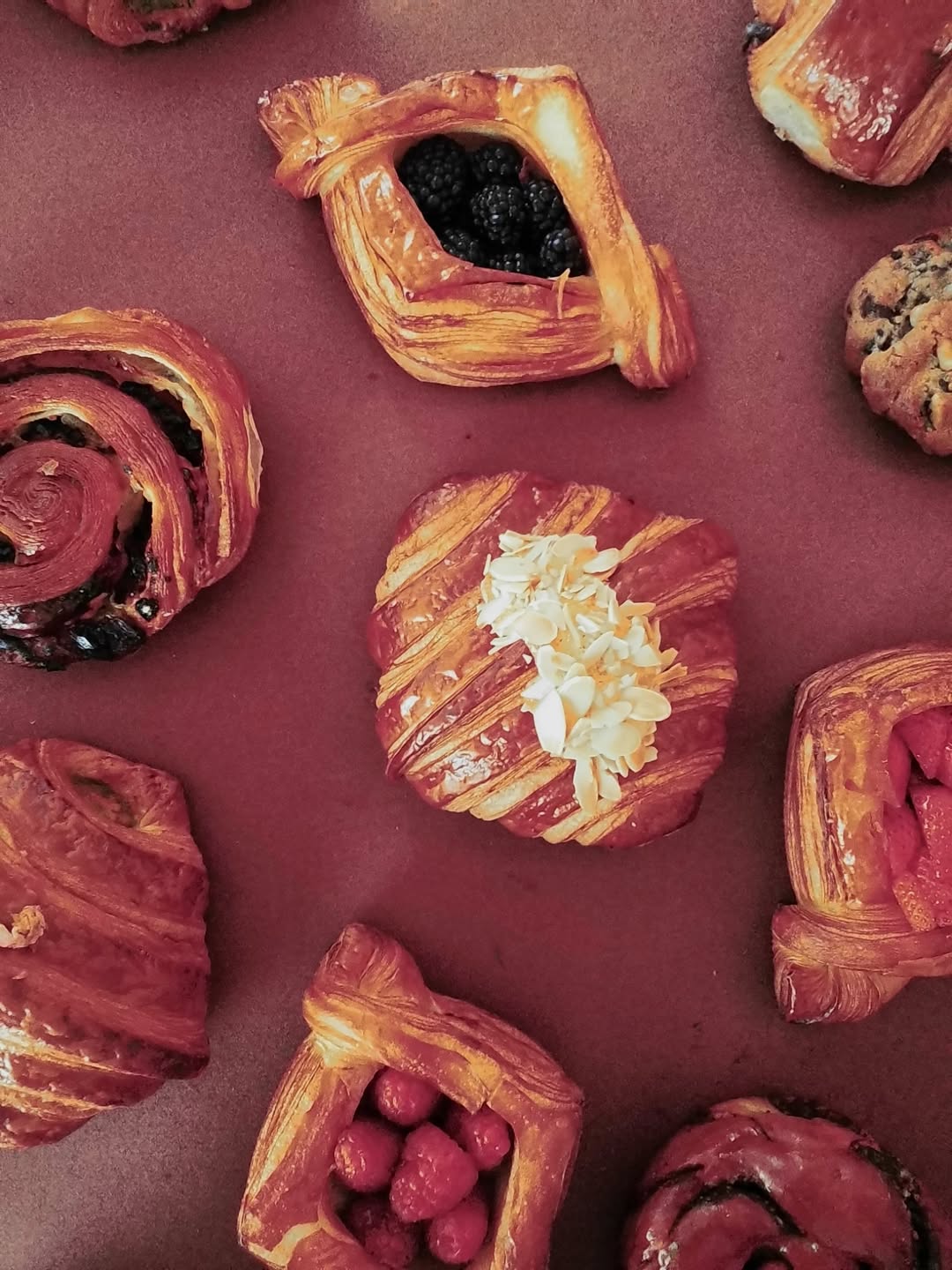
Lay a dozen pastries across a deep red board and you start to notice how different they really are from each other. Blackberries pool inside one folded square. Almonds scatter across another, still catching the light from a sugar glaze. A few steps away, a spiral of chocolate curls in on itself, and raspberries sit stacked like they were placed there by hand, not just filled in.
That variety is not incidental. It reflects something we believe at Artelice: that a pastry case should hold more than one mood. Some mornings call for something bright and fruited, the kind of bite that feels like it belongs to a specific person you are thinking about. Other mornings call for something dense and chocolate, the kind you keep for yourself and do not explain to anyone.
We think of every piece that leaves our kitchen as a small decision made on someone else's behalf. The berries have to be placed, not dropped. The almonds have to be scattered with some sense of where they will land. None of it is complicated in theory, but it takes time to do consistently, tray after tray, without the shortcuts starting to show.
Look closely and the differences matter more than the similarities. The blackberry pastry is folded into a diamond, open at the top so the fruit stays visible instead of buried. The almond piece is round, its glaze striped rather than solid, which lets the sliced almonds sit in clusters instead of spreading evenly. Small choices like that change how a bite reads before it even reaches your mouth.
The chocolate roll is coiled tight, its layers visible from above like rings in wood. It sits next to a raspberry filled pastry that takes a completely different shape, open and boat like, built to hold fruit rather than wrap around it. Nothing on the board is trying to look like anything else. Each shape exists because it serves a particular filling.
We do not use that phrase lightly. A pastry does not need to be complicated to mean something. Sometimes it is bought for a partner on the way out the door. Sometimes it is bought alone, eaten standing at a counter, with no occasion attached to it at all. Both versions count. The ingredients and the time behind them do not change depending on who is receiving it.
That is really the invitation behind today: come in and pick whichever one matches how you feel, not which one looks most impressive. The berry pastries are for someone who wants brightness. The almond one is for someone who wants a little crunch with their coffee. The chocolate roll is for someone who does not need convincing.
We will keep making the tray look like this, a little different every day depending on what is fresh and what is finished first. If you come in today, take a minute before you choose. The right pastry is usually the one you were already thinking about walking through the door.
Draft story for artelicela.com · Pastry Notes
Our signature raspberry Danish starts with dough laminated fresh every morning and ends with fruit placed by hand.
At Artelice, the raspberry Danish begins the way most of our pastries do, with dough that gets laminated fresh every morning before the ovens are even at temperature. That single step shapes everything that follows. Lamination is what turns a flat piece of dough into something with structure, and it is why the finished pastry can hold its shape while staying tender enough to pull apart with a fork.
The dough is folded, then rested, then folded again, a rhythm that has to happen in a specific order for the layers to form correctly. Rushing that process flattens the result. Giving it time is what allows the edges to turn golden and crisp while the center stays soft. It is a quiet, repetitive kind of work, and it happens well before the raspberries ever enter the picture.
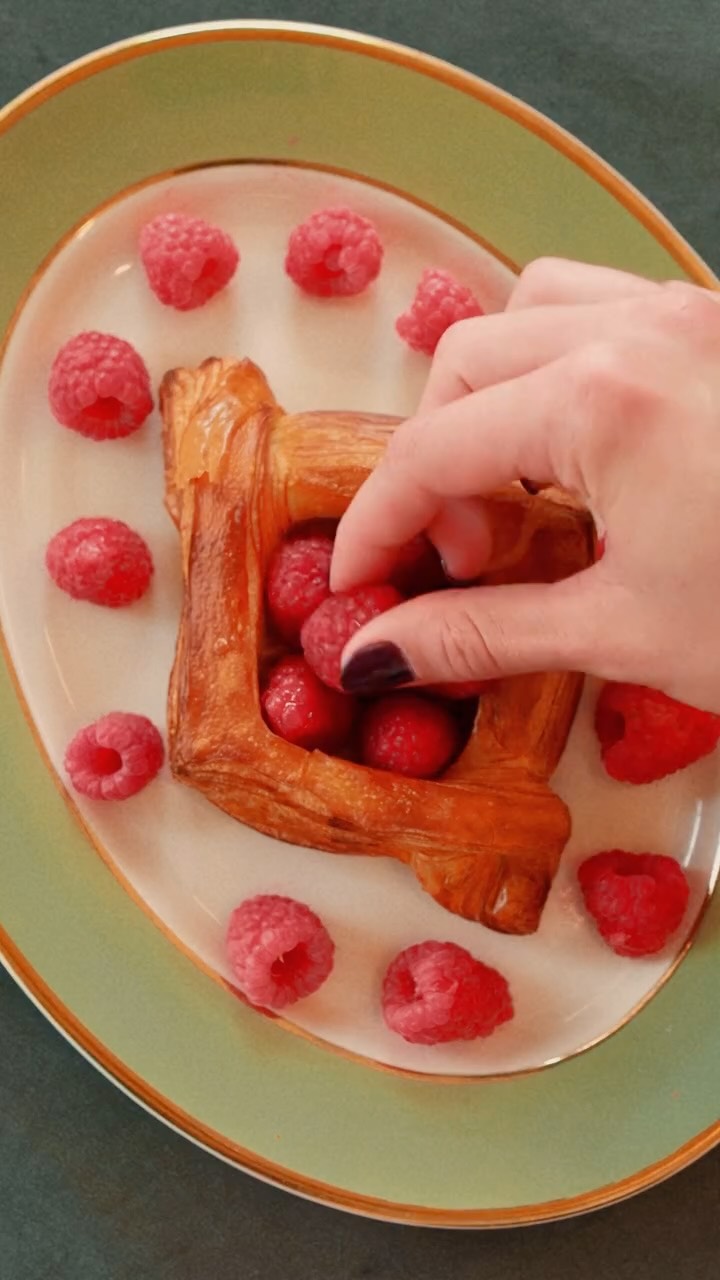
The raspberry Danish takes its familiar square frame, with the corners folded up and over to hold everything in place. That structure is not just visual. It creates a shallow well in the center, low walled but sturdy, built specifically to hold fruit without letting it spill over the sides once it bakes. The shape is functional first, and the look follows from that.
Once baked, that center becomes the base for fresh raspberries, placed directly onto the warm pastry rather than baked in from the start. Keeping the fruit separate until the end means the raspberries stay whole and bright instead of breaking down in the oven's heat. The berries sit loosely inside the frame, easy to arrange by hand, easy to see clearly against the golden pastry underneath.
There is a practical reason for building the Danish this way. Raspberries are delicate, and heat changes them fast. Adding them after the dough has finished baking protects their texture and keeps their color from dulling. It also means the fruit stays cool and slightly firm against pastry that is still warm from the oven, a contrast that only works if the two are combined at the right moment.
That timing is also why we encourage people to taste it fresh from the oven. A Danish that has cooled for hours loses some of that contrast between warm, crisp pastry and cold, just placed fruit. Catching it soon after it comes out is when the texture is doing exactly what it was built to do, before the layers have had time to soften from sitting.
Assembling the raspberry Danish is deliberate work, one berry set into place after another until the center is full without crowding the frame. It is not a pastry that gets rushed at the finishing stage, even though the dough itself has already taken hours to prepare. The last few minutes are just as intentional as the lamination that came before them.
What ends up on the plate is a pastry defined by contrast, crisp against soft, warm against cool, structured dough around loose fruit. None of that happens by accident. It comes from a process built in stages, each one dependent on the last, finishing with something as simple as fresh raspberries placed by hand into a frame made to hold them.
Draft story for artelicela.com · Pastry Notes
Artelice Patisserie turns fresh mango and passion fruit into a dessert built to look exactly like the fruit it is made from.
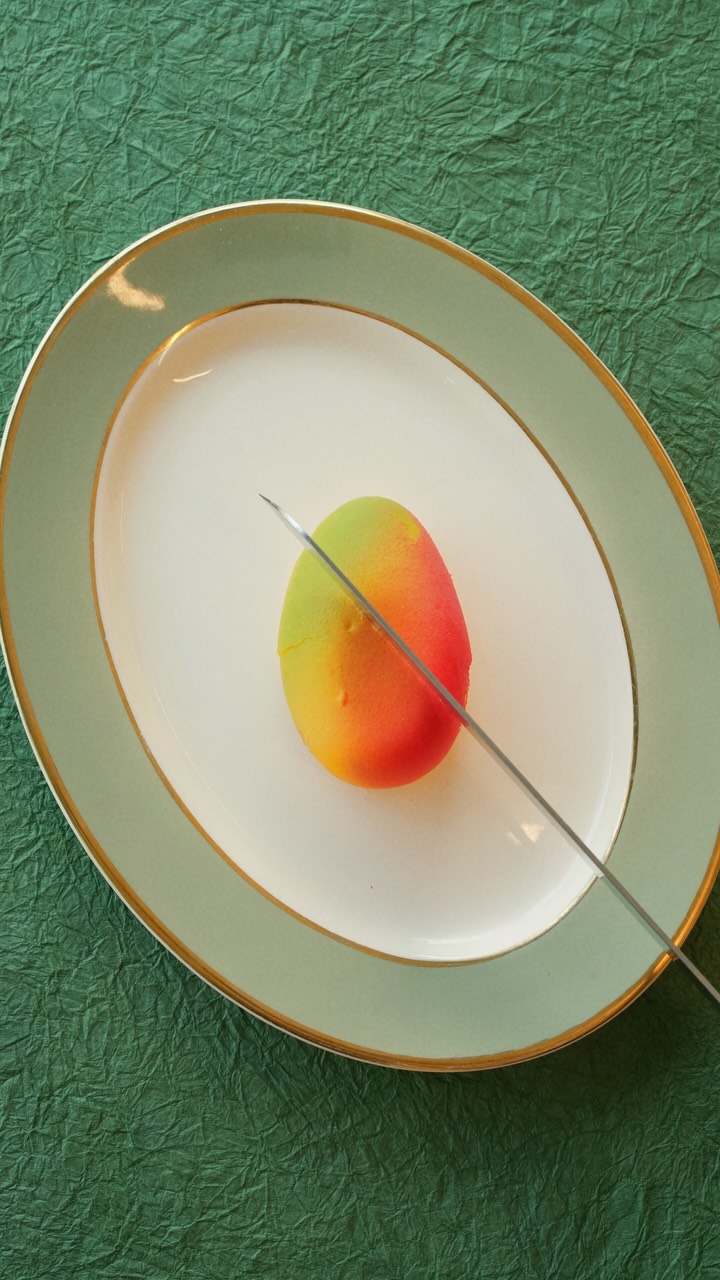
A knife rests against the curved side of what looks like a whole mango, sitting alone on a gold rimmed plate. The skin shifts from green to yellow to a deep blush red, the same gradient you would find at a produce stand. Only the blade gives it away. This is not a piece of fruit at all. It is our Mango Passion Fruit pastry, shaped and colored to hold that illusion until the moment it is cut.
We built it around fresh mango, which shapes both the flavor and the idea behind the dessert. Instead of folding the fruit into a familiar tart shell or layering it into a cake, we let the mango define the form itself. The result is a pastry that asks to be looked at before it is eaten, since the shape alone does most of the introducing.
Passion fruit runs underneath that mango exterior, giving the dessert its edge. Where mango leans soft and rounded in flavor, passion fruit brings something sharper and more citrus forward. The combination keeps the pastry from settling into simple sweetness. It moves instead, shifting from bright fruit up front to a tangier finish that lingers a little longer than the first bite suggests.
We describe it as light and refreshing, and that description comes directly from how the pastry is built. There is no attempt to make it heavier or richer than the fruit itself. Not too sweet is a deliberate choice here, not a compromise. The mango carries the top notes, the passion fruit carries the finish, and neither one is buried under excess sugar or cream.
The plate itself plays a role in the presentation. A single mango shaped pastry, centered on white china with a thin gold rim, reads more like a piece placed on display than a slice served at a table. The knife entering from one side is the only clue that this is meant to be cut open rather than simply admired, which is exactly the tension the dessert is built on.
Shaping a pastry to mimic real fruit is a technical choice as much as a visual one. Getting the gradient right, from green at the top to red at the base, and getting the surface to hold that soft matte finish, takes precision most fillings never have to account for. The shape is not decoration added afterward. It is the structure the whole pastry is built around from the start.
Cutting into it is where the pastry stops behaving like fruit and starts behaving like dessert. Whatever texture waits beneath that mango colored shell is the actual reveal, the part the exterior has been quietly setting up. The passion fruit tang meets the mango sweetness right at that first cut, which is the moment the whole shape has been building toward.
It is a small dessert with a specific idea behind it: take a shape everyone already recognizes and use it to carry a flavor pairing that is more layered than it first appears. Fresh mango gives it familiarity. Passion fruit gives it edge. The knife on the plate is simply an invitation to find out what is actually inside.
Keep reading