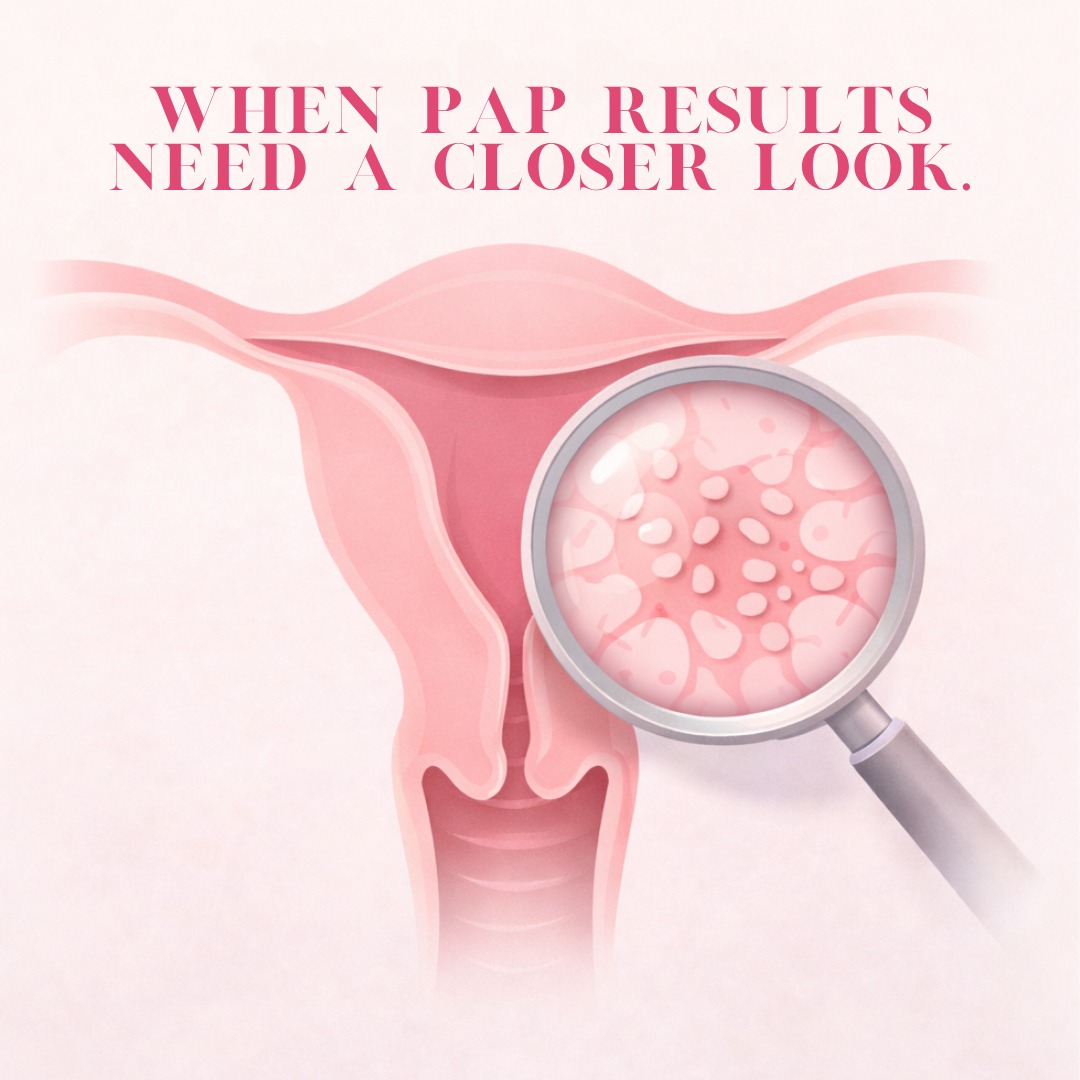
What an abnormal Pap result actually means for your next appointment
A colposcopy is a simple in office step that gives our team a closer look at cervical tissue before deciding on treatment.
ADVANCED OBGYN STAFFTurn your social into search
We turn your posts into editorial stories that bring new search traffic to advanced-obgyn.com. Three of yours will be on this page.
Book a demo
advancedobgynnyc If your Pap results come back abnormal, a colposcopy may be the next step. This simple in office procedure allows our team to examine your cervical tissue more closely and determine whether any treatment is needed. Early evaluation is key and we are here to guide you through it every step of the way. 📞 Call us today to schedule an appointment. #Colposcopy #CervicalHealth #PreventiveCare #WomensHealth
A colposcopy is a simple in office step that gives our team a closer look at cervical tissue before deciding on treatment.
ADVANCED OBGYN STAFFHow it works
Same as today. Nothing changes on Instagram.
We turn your post into a full story in your voice within the hour.
One click publishes it to advanced-obgyn.com. Nothing goes live without you.
Your stories
Nothing was published anywhere. You decide that. Every word will come from your own posts, your own photos and your own treatments.
Cervical Health · From your post
A colposcopy is a simple in office step that gives our team a closer look at cervical tissue before deciding on treatment.
“If your Pap results come back abnormal, a colposcopy may be the next step. This simple in office procedure allows our team to examine your cervical tissue more closely and determine whether any treatment is needed. Early evaluation is key and we are here to guide you through it every step of the way. 📞 Call us today to schedule an appointment. #Colposcopy #CervicalHealth #PreventiveCare #WomensHealth”

Menstrual Health · From your post
Before reaching for another heating pad, consider what heavy or painful periods might actually be telling you.
“Heavy or painful periods are not something you simply have to live with. Many treatment options exist to help manage symptoms and improve quality of life. Identifying the underlying cause is an important first step. Schedule a consultation to explore your options. #MenstrualHealth #HeavyPeriods #WomensWellness #OBGYNCare #PeriodHealth”

Prenatal Care · From your post
Comprehensive prenatal support means tracking the baby while also caring for the mother's body, mind, and comfort.
“Pregnancy care involves more than monitoring fetal development. Providers also evaluate maternal health, nutrition, and emotional well being throughout the process. Comprehensive care supports both mother and baby. Stay connected with your prenatal team throughout pregnancy. #PregnancyCare #MaternalHealth #PrenatalVisits”
One social post becomes another searchable entry point to Advanced OBGYN.
Our own magazine. Clicks and citations from Google Search Console, as of September 15, 2026.
Draft story for advanced-obgyn.com · Cervical Health
A colposcopy is a simple in office step that gives our team a closer look at cervical tissue before deciding on treatment.
An abnormal Pap result is one of the most common reasons a patient calls us feeling uneasy. The word abnormal sounds alarming on its own, but in practice it simply means the initial screening found something that deserves a closer look. It does not confirm a diagnosis. It is a signal that guides what we do next, and for many patients that next step is a colposcopy.
A colposcopy is not a separate, complicated procedure. It is an in office visit where we examine the cervical tissue directly and in more detail than a standard Pap allows. We are looking at the surface of the cervix closely enough to see patterns and changes that would otherwise be invisible during a routine exam, which is exactly the point of taking this extra step.
A Pap test is a screening tool, and screening tools are designed to flag possibility rather than certainty. When results come back abnormal, the honest answer is that we do not yet know what is causing that result. A colposcopy lets us move from a general flag to a specific, visual assessment of the tissue itself, which is what actually determines whether treatment is needed.
This is also why we describe early evaluation as key rather than optional. Cervical changes exist on a spectrum, and most of that spectrum resolves on its own or requires only monitoring. Identifying where a patient falls on that spectrum earlier gives us more options and more time, rather than waiting until a question becomes something more urgent to address.
Because a colposcopy is performed in office, there is no separate facility to schedule, no extended recovery window built into the day, and no need to treat it as a major event. It is designed to fit into the same kind of appointment slot as other gynecologic care, which keeps the process from becoming another source of stress on top of an already worrying result.
During the procedure, our team examines the cervical tissue closely to determine whether the changes seen are minor, whether they need monitoring over time, or whether treatment is warranted now. That determination is specific to what is actually observed in that visit, and it is the reason we do not make assumptions about treatment before the tissue has actually been evaluated in person.
We are here to guide patients through this every step of the way, from the moment an abnormal result comes in through whatever comes after the colposcopy itself. That guidance matters because uncertainty is often the hardest part of this process, more than the appointment itself. Knowing what a result means, what happens next, and why each step exists changes how manageable it feels.
If a recent Pap result has come back abnormal, the most useful next move is simply to talk it through with us rather than sit with it. Call to schedule a colposcopy, and we will walk through what a closer look actually shows and what, if anything, needs to happen from there.
Draft story for advanced-obgyn.com · Menstrual Health
Before reaching for another heating pad, consider what heavy or painful periods might actually be telling you.
A heating pad pressed against the lower abdomen is a familiar routine for a lot of women. It gets you through the afternoon, the meeting, the day. But reaching for it month after month is worth pausing on. Heavy or painful periods are common, which is different from being normal, and that distinction matters more than most people realize.
We hear some version of the same story often. Someone has managed her period pain for years, quietly, privately, assuming it is simply her body's baseline. She has built her calendar around it, planned around it, apologized for it. What she has not done is ask whether the pain itself is a symptom pointing toward something identifiable and treatable.
Heavy and painful are subjective words until you start asking specific questions. How many hours between changing a pad or tampon. Whether clots are present and how large. Whether pain interferes with work, sleep, or plans. These details are not embarrassing, they are clinical information, and they are usually the first thing we walk through together in a consultation.
Underlying causes range widely, from hormonal imbalances to structural issues within the uterus, and each points toward a different path forward. That is why identifying the cause matters more than simply treating the symptom. Two women with similar pain levels may need entirely different care, and guessing at that difference alone, without evaluation, tends to waste time rather than save it.
The encouraging part is that once a cause is identified, there are usually several treatment paths to consider, not just one. Some are lifestyle based, some are medical, and some are procedural depending on what is actually driving the symptoms. None of that can be determined from a phone screen or a symptom checklist. It requires an actual conversation and an actual exam.
That first conversation is often the hardest part to schedule, not because the appointment itself is difficult, but because so many women have learned to minimize what they are feeling. We would rather hear about it directly. Bring the details you have been tracking, even loosely, and let us help you sort out what is worth investigating further.
A consultation is not a commitment to any particular treatment. It is simply the starting point for figuring out what is actually happening in your body, and what, if anything, needs to change. We treat it as a diagnostic conversation first, options second, decisions only once you have enough information to make one confidently.
If your periods have quietly shaped how you plan your months, that pattern is worth naming out loud to someone who can help. Painful periods are not a personality trait or an inconvenience to be managed indefinitely on your own. They are a symptom, and symptoms are worth understanding. That is the entire premise behind starting with a consultation.
Draft story for advanced-obgyn.com · Prenatal Care
Comprehensive prenatal support means tracking the baby while also caring for the mother's body, mind, and comfort.
When people think about prenatal visits, they usually picture one thing: the ultrasound. The heartbeat, the measurements, the growth chart. That part matters, and it stays central to every appointment. But it is only one piece of what actually happens during pregnancy care, and treating it as the whole picture leaves out most of what a mother experiences week to week.
Fetal development gets tracked closely for good reason. Still, a pregnant body is doing far more than growing a baby. It is adjusting hormone levels, shifting posture, changing how it processes food, and carrying new physical strain in the back, hips, and joints. Comprehensive care means paying attention to all of that alongside the standard measurements, not instead of them.
Nutrition is one of the clearest examples. What a mother eats affects her own energy and recovery just as much as it affects the baby's growth. A thoughtful prenatal team looks at eating patterns, deficiencies, and cravings as real clinical information, not small talk before the exam. That conversation belongs in the appointment, not as an afterthought at the end.
Emotional well being deserves the same weight. Pregnancy brings mood changes, anxiety, and physical discomfort that can be hard to name out loud. Asking about sleep, stress, and how someone is coping is part of evaluating maternal health, not a separate concern. A mother who feels steady and supported is better equipped for labor, recovery, and the early weeks with a newborn.
Some of that support is physical. Touch, pressure, and simple relief for a tired, changing body are part of caring for the whole person, not just the pregnancy. A moment of rest on the table, a hand placed with intention, a few quiet minutes without appointments stacked on top of each other, all of it adds up to care that acknowledges what the body is carrying.
None of this replaces medical monitoring. It sits alongside it. A mother who is nourished, supported, and heard tends to show up differently for the next visit, and that steadiness carries through the rest of the pregnancy. Comprehensive care treats those two things, the clinical and the personal, as connected rather than separate boxes to check.
This is why staying connected with a prenatal team matters more than any single appointment. Pregnancy changes week to week, and a provider who sees that pattern over time can catch small shifts early, whether physical or emotional. Consistency lets care adjust as the body does, instead of resetting the conversation from scratch every visit.
Comprehensive pregnancy care is really about attention paid in more than one direction at once: to the baby developing, to the mother carrying that baby, and to everything in between that makes the nine months feel manageable rather than just monitored.
Keep reading